

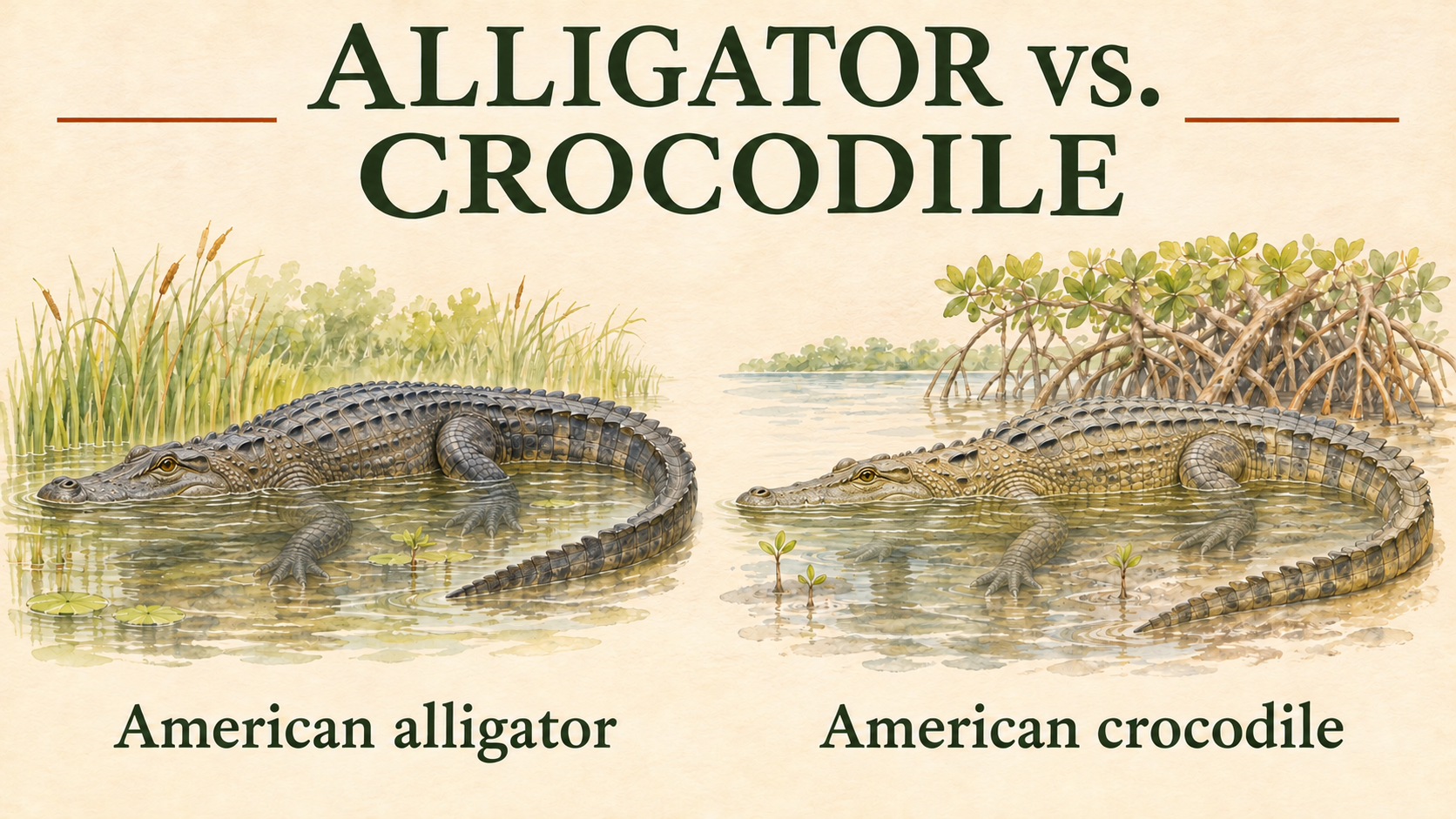
An alligator and a crocodile can look remarkably similar at first glance. Both have armored backs, powerful tails, and long jaws lined with teeth. The quickest clues are usually the snout and the teeth: an American alligator has a broad, rounded snout, while an American crocodile has a narrower, more tapered one and an enlarged lower tooth that shows when its mouth is closed.
That familiar comparison is a useful starting point, but crocodiles come in many shapes and sizes. This guide explains seven differences, using the American species for the main visual comparison and pointing out the exceptions that matter elsewhere.
Alligator vs. Crocodile at a Glance
| Feature | Alligators | Crocodiles |
|---|---|---|
| Snout | Usually broad and rounded | Often more tapered; some species have broad snouts |
| Fourth lower tooth | Usually hidden when the mouth is closed | Visible in a notch when the mouth is closed |
| Color | American adults often look dark gray or nearly black | American adults often look lighter gray-green |
| Water | Mainly freshwater; can enter brackish water | Freshwater, brackish water, or saltwater, depending on species |
| Native range | Southeastern United States and eastern China | Parts of the Americas, Africa, Asia, and Australia |
| Size | American alligators are much larger than Chinese alligators | Varies greatly; saltwater crocodiles are the largest living reptiles |
| Cold tolerance | American alligators tolerate colder conditions than American crocodiles | American crocodiles are restricted to warmer areas |
Related Reptiles from Different Families
Alligators and crocodiles both belong to the reptile group called crocodilians. Within that group, alligators belong to the family Alligatoridae, alongside caimans. True crocodiles belong to Crocodylidae. Gharials and false gharials form another family, Gavialidae.
So, an alligator is a crocodilian, but it is not a true crocodile. The distinction is about its evolutionary family, rather than how large it grows or whether it lives in a swamp.
1. Snout Shape
Viewed from above, an American alligator has a wide, rounded snout that is often described as U-shaped. An American crocodile has a longer-looking, narrower snout that tapers toward the nose, giving it a more triangular or V-shaped outline.
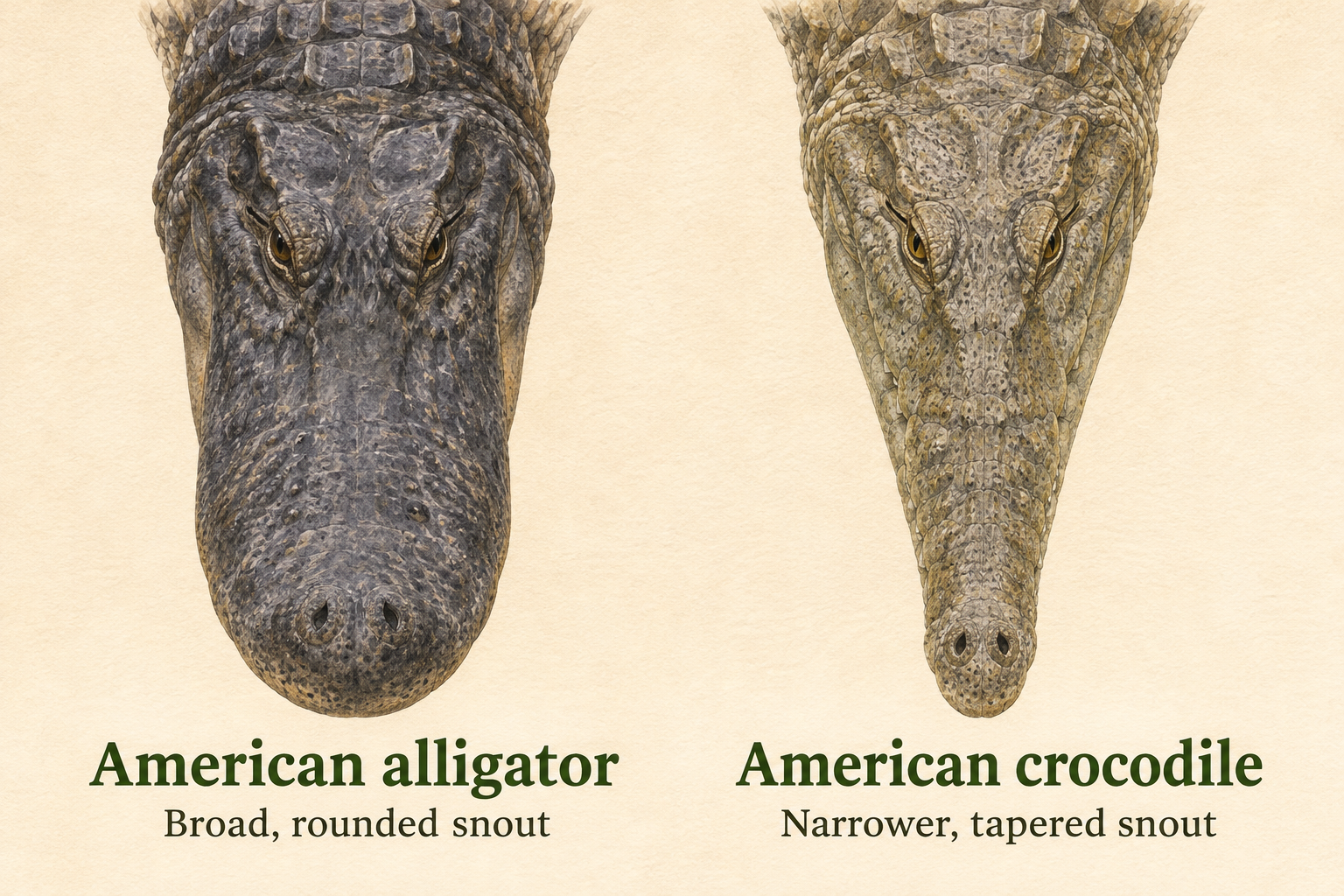
The U-versus-V rule works well for this pair, but it cannot identify every crocodilian. The mugger crocodile has a broad snout, and an adult saltwater crocodile can have a heavy, broad head too. Use snout shape together with the jaw, teeth, and location.
2. Teeth Visible with the Mouth Closed
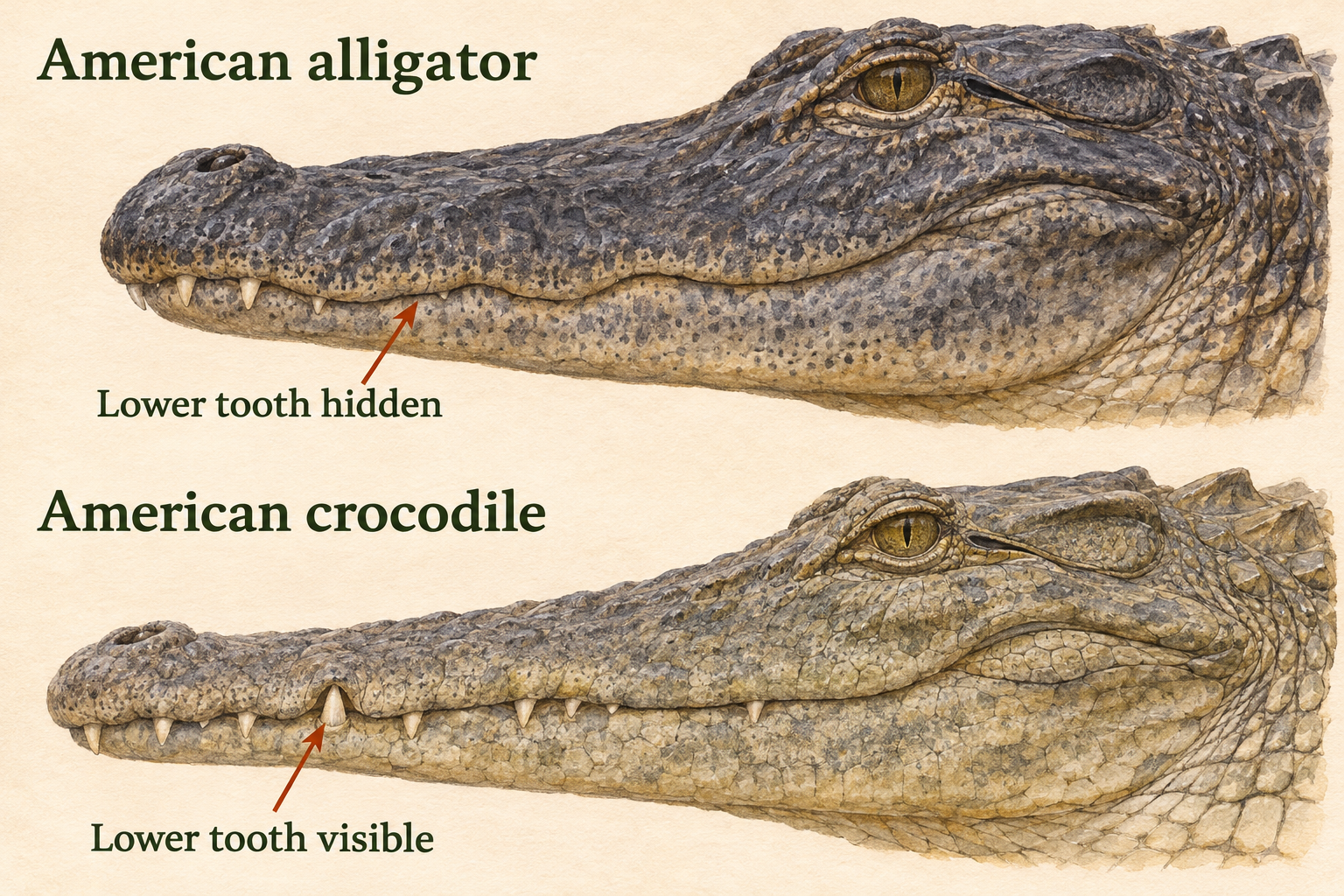
An alligator’s upper jaw is wider than its lower jaw. When the mouth closes, the enlarged fourth tooth on each side of the lower jaw fits into a socket in the upper jaw, hiding its tip. You can usually see upper teeth along the closed mouth.
In a true crocodile, that enlarged lower tooth sits in an external notch and remains visible beside the upper jaw. This gives the closed mouth a more interlocking appearance. The important feature is the position of that lower tooth, rather than the total number of teeth you can count. Look for it in a clear photograph or through binoculars.
3. Body Color
Adult American alligators often appear dark gray or almost black. American crocodiles generally have a lighter, grayish-green appearance. In a clear view, that difference can support an identification based on the head and jaws.
Color is a supporting clue rather than a firm rule. Alligators can also look olive or brown, and algae and the water they live in can change their appearance. Other crocodile species have their own patterns and colors, so a dark animal is not automatically an alligator.
4. Freshwater and Saltwater Habitats
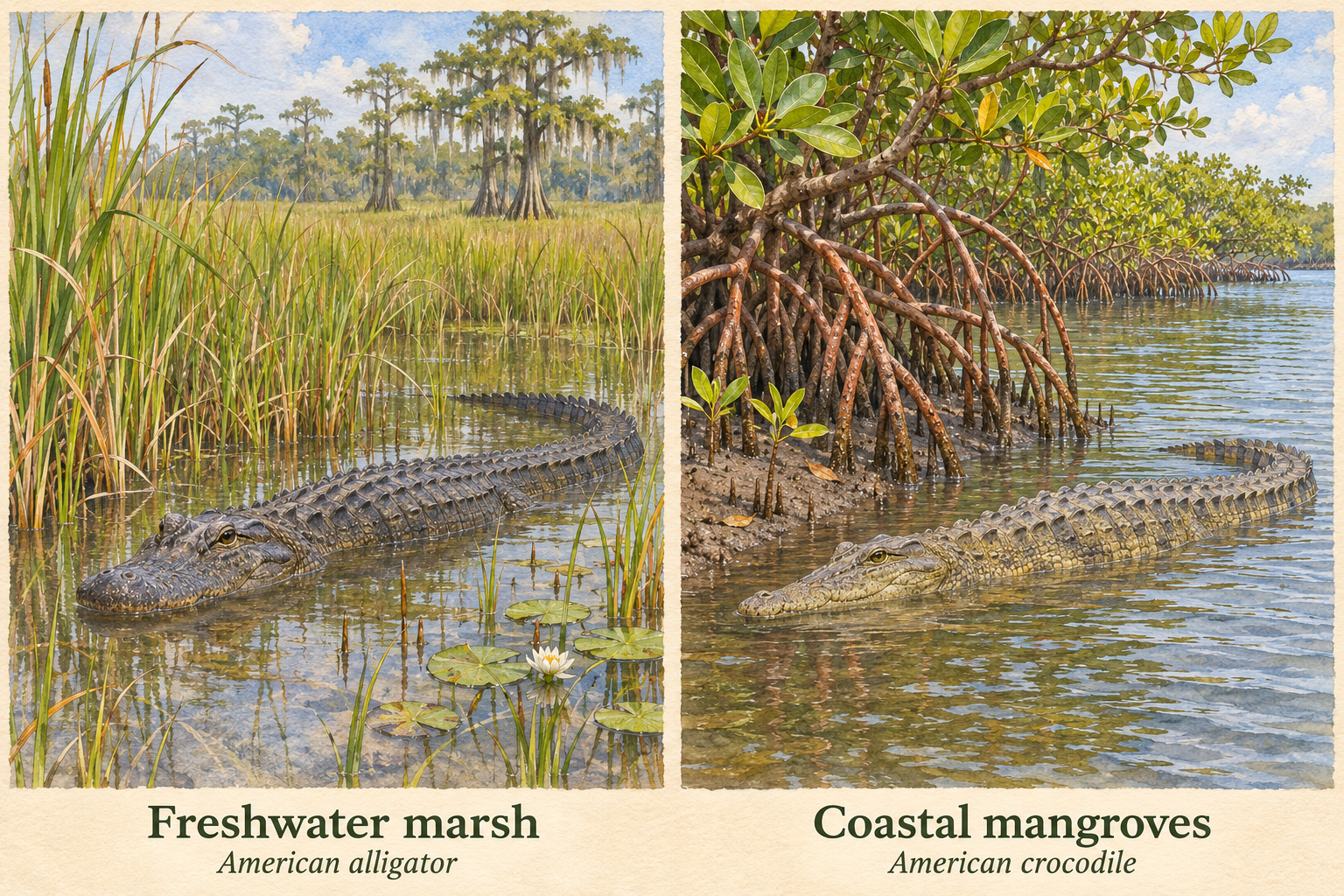
Alligators mainly live in freshwater environments such as lakes, rivers, marshes, and swamps. Crocodiles have functioning salt-excreting glands on their tongues, which help them remove excess salt. Alligators lack the same ability to deal with a salty environment for long periods.
That helps explain why American crocodiles live around coastal mangroves, bays, and estuaries. These areas often contain brackish water, a mixture of freshwater and seawater. Alligators can enter brackish water too, so finding one near the coast is possible.
Crocodiles are not restricted to saltwater. Australia’s freshwater crocodile lives in rivers and other freshwater habitats, and even the saltwater crocodile uses freshwater rivers, pools, and swamps. Water type can narrow the possibilities, but it cannot settle the identification on its own.
5. Where They Live
The two living alligator species have very different native homes. The American alligator lives in the southeastern United States. The smaller Chinese alligator lives in eastern China, with its remaining wild range concentrated around the lower Yangtze River region.
Crocodiles have a much wider collective range, with native species in parts of the Americas, Africa, Asia, and Australia. For example, American crocodiles occur from southern Florida through parts of the Caribbean and Central America into northern South America. Saltwater crocodiles occur in parts of Asia and northern Australia.
Southern Florida is unusual because native American alligators and American crocodiles live in the same region. There, the animal’s location alone cannot tell you which one you are looking at.
6. Adult Size
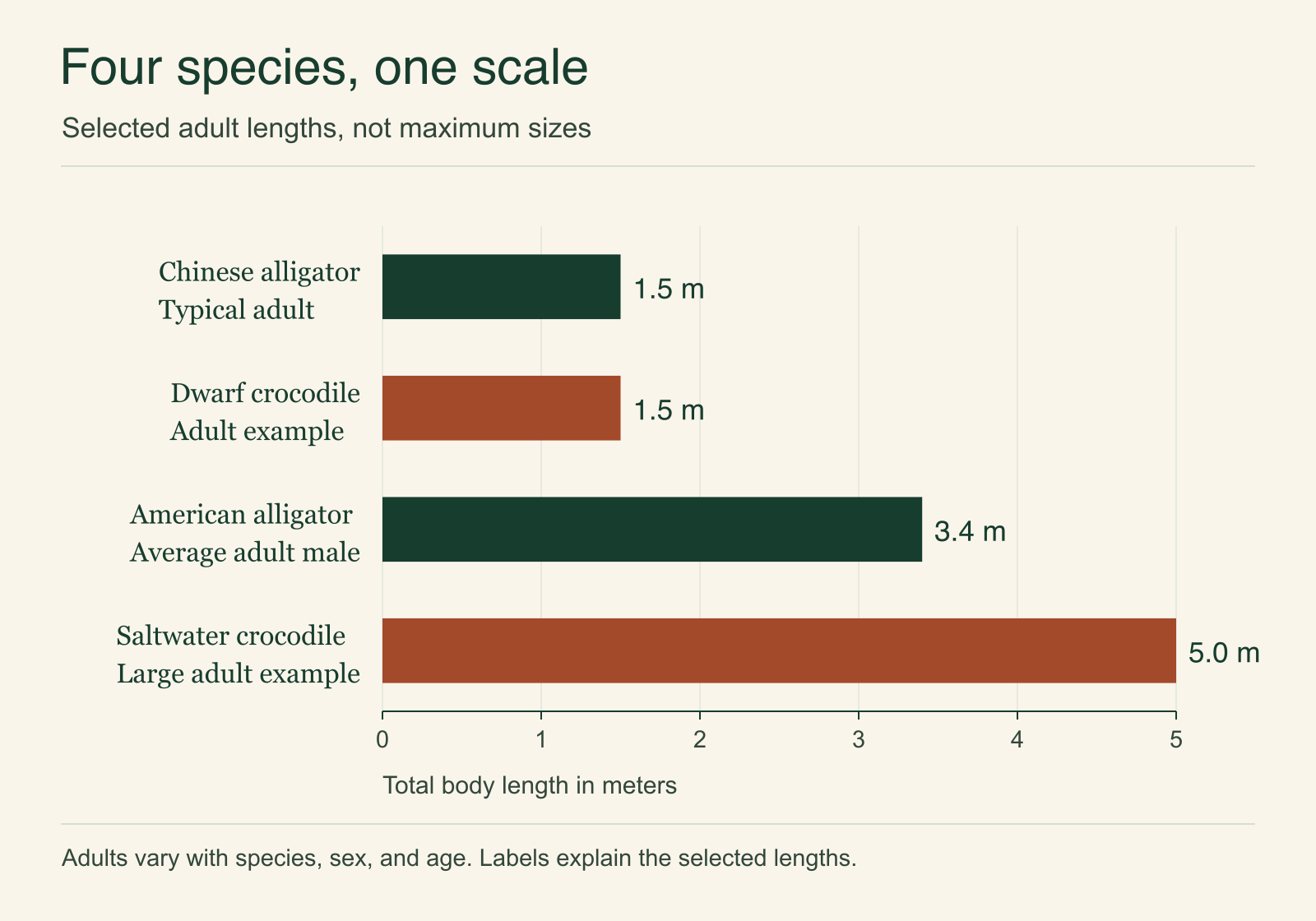
The largest crocodiles grow bigger than the largest alligators, but there is a great deal of overlap. The saltwater crocodile is the largest living reptile; exceptionally large individuals exceed 6 meters (about 20 feet). That does not make every crocodile a giant.
American alligators are substantial animals. Adult males average about 3.4 meters (11 feet), and large males can reach roughly 4–4.6 meters (13–15 feet). Females are usually smaller. Chinese alligators, by comparison, usually reach about 1.5 meters (5 feet).
At the small end of the crocodile family, dwarf crocodiles generally stay below 2 meters (about 6.6 feet). A large American alligator can therefore be much bigger than an adult dwarf crocodile. Species, sex, and age all matter, making size a poor identification shortcut.
7. Tolerance of Cold Weather
American alligators tolerate colder conditions than American crocodiles. That difference helps explain their wider range across the southeastern United States, while American crocodiles reach the northern edge of their natural range in southern Florida.
Both animals rely on their surroundings to regulate body temperature. They bask to warm up and move into cooler water or shade when they need to lose heat. In cold weather, American alligators become less active and may shelter in burrows. Chinese alligators also spend winter in underground burrows.
This is a difference in tolerance, rather than an ability to make their own heat. An alligator still depends on suitable conditions to stay active, digest food, and grow.
What Alligators and Crocodiles Have in Common
Their similarities go beyond a long tail and a toothy grin. Both are predators that eat a variety of animals, with smaller prey especially important for youngsters. Both lay eggs, and mothers of the American species guard their nests and can carry hatchlings to water in their mouths.
Behavior also varies within each group. American crocodiles are generally shy, so the idea that every crocodile is unusually aggressive is misleading. An animal resting with its mouth open may be regulating its temperature. Neither its name nor a calm appearance makes it safe to approach: watch from a distance and never feed either animal.
Explore More Animals
For the American pair, start with the broad or tapered snout, then check the visible lower tooth in a clear view. Color and habitat add context, while species differences explain the exceptions. Meet more reptiles and other wildlife in our guides to animals that start with A and animals that start with C.


James Miller grew up on the Oregon coast, exploring tide pools and watching seabirds. He has a particular fondness for owls and keeps a notebook of his bird sightings.
Read More »