A tortoise is a kind of turtle adapted to life on land. Its sturdy legs and unwebbed feet usually give it away. Many other turtles live in fresh water or the sea, where webbed feet or broad flippers help them swim. That makes the limbs a useful first clue, but shell shape and the animal’s exact species still matter.
The names can be confusing because people often use “turtle” for an aquatic animal and “tortoise” for a land animal. In the broader biological sense, turtle includes tortoises too. These reptiles share the same basic shell-bearing body plan; their differences reflect the habitats and ways of moving found within the group.
Turtle and Tortoise Differences at a Glance
| Feature | Aquatic turtles | Tortoises |
|---|---|---|
| Usual habitat | Fresh water or the sea, depending on species | Land |
| Limbs | Often webbed feet; sea turtles have flippers | Sturdy legs with unwebbed feet |
| Shell outline | Often relatively streamlined | Often domed, with important exceptions |
| Breathing | Lungs; sea turtles must surface for air | Lungs |
| Food | Varies greatly; some eat plants, animals, or both | Generally plant-eating |
| Eggs | Laid on land, including by sea turtles | Laid on land |
| Naming caveat | Some turtles, including box turtles, are largely terrestrial | All tortoises belong within the wider turtle group |
1. Start with Feet and Flippers
A sea turtle has flattened limbs shaped for swimming. Its large front flippers are very different from the separate, clawed toes visible on many freshwater turtles. A red-eared slider, for example, has webbing between its toes. That webbing provides a broader surface for moving through water while leaving the animal with recognizable feet.
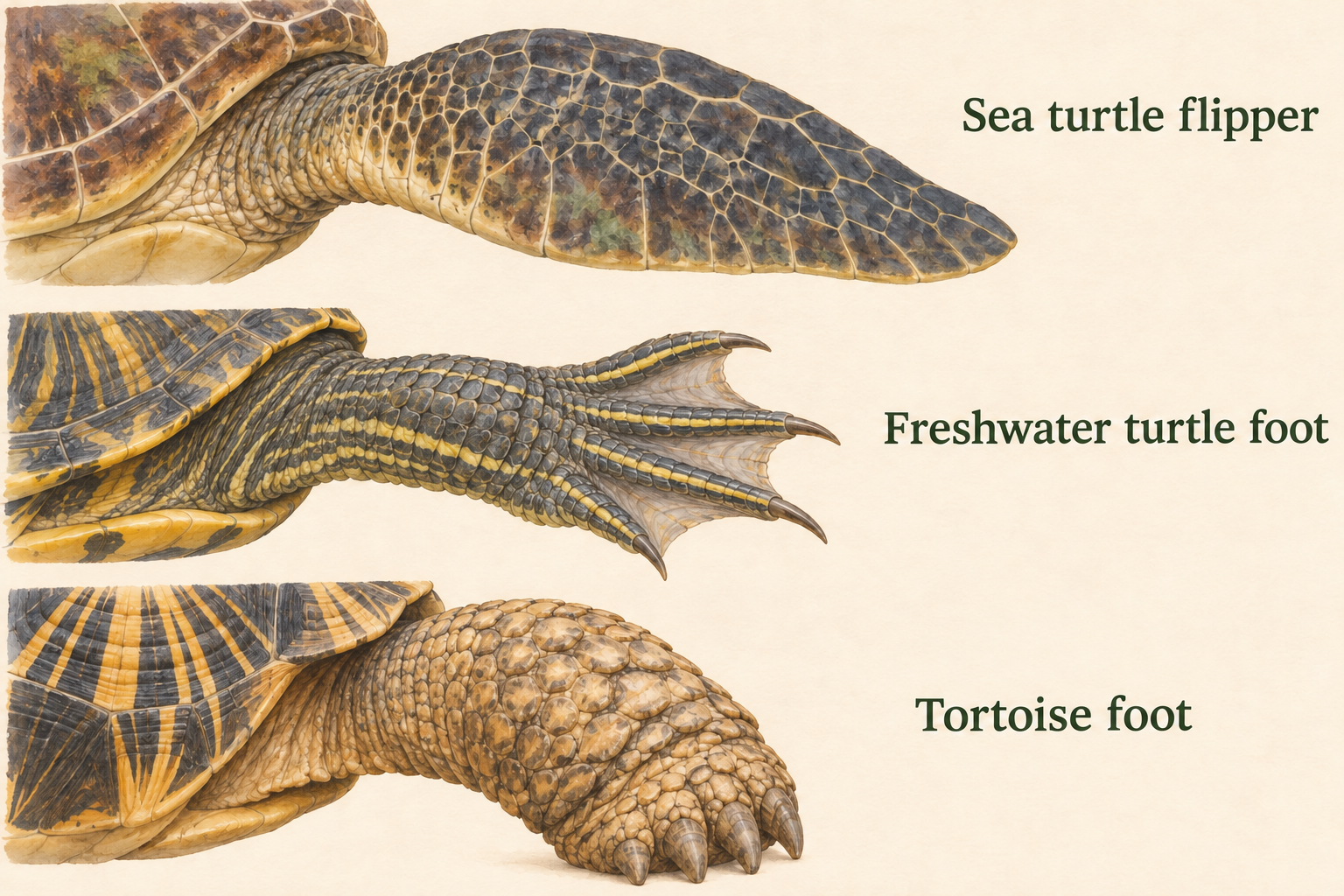
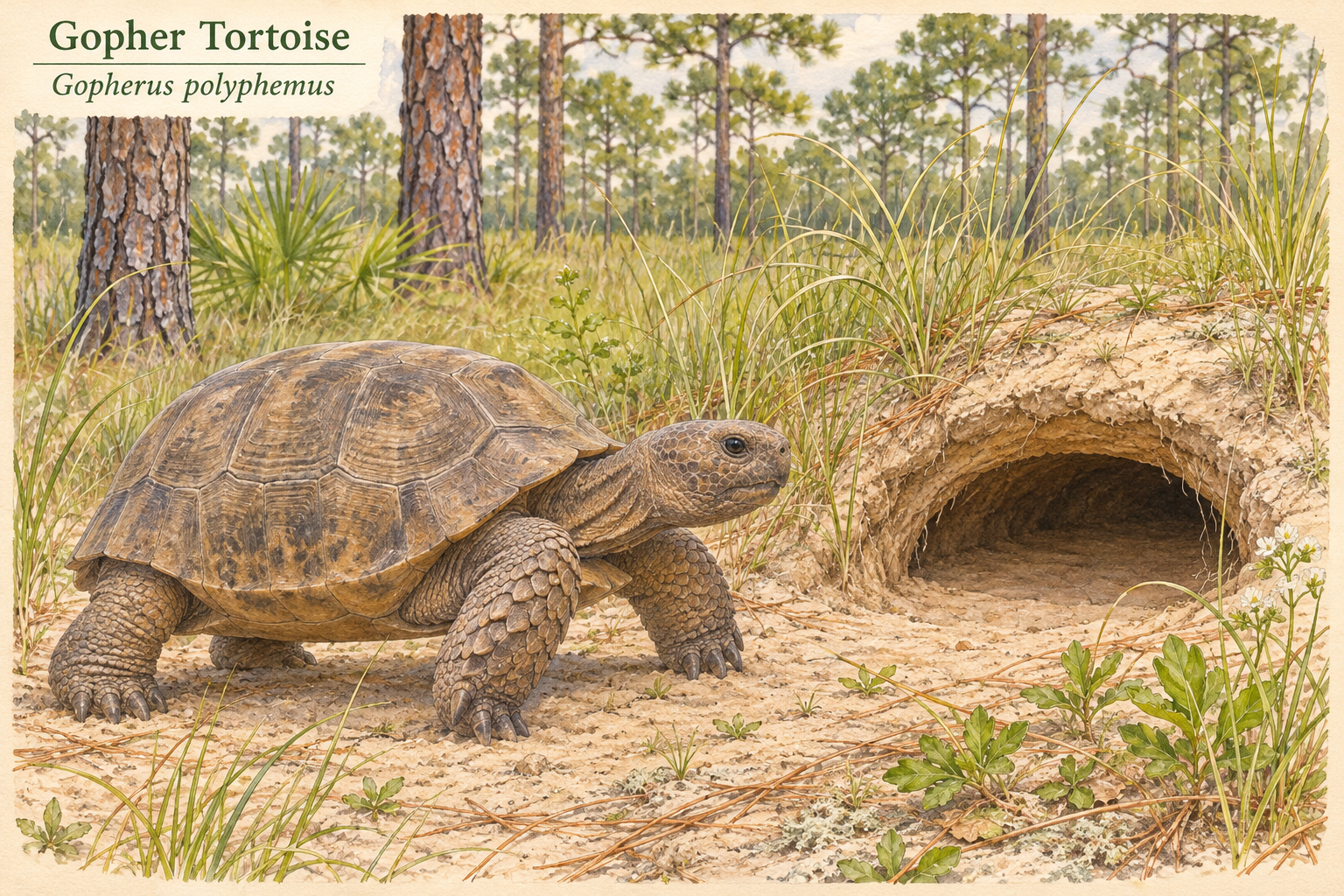
Tortoise feet carry a walking body rather than serving as paddles. The radiated tortoise has thick, elephant-like feet, while the gopher tortoise has especially broad front feet suited to digging. Looking at both the front and rear limbs is more informative than judging an animal only by whether it happens to be beside a pond.
2. Shell Shape Helps, but It Has Exceptions
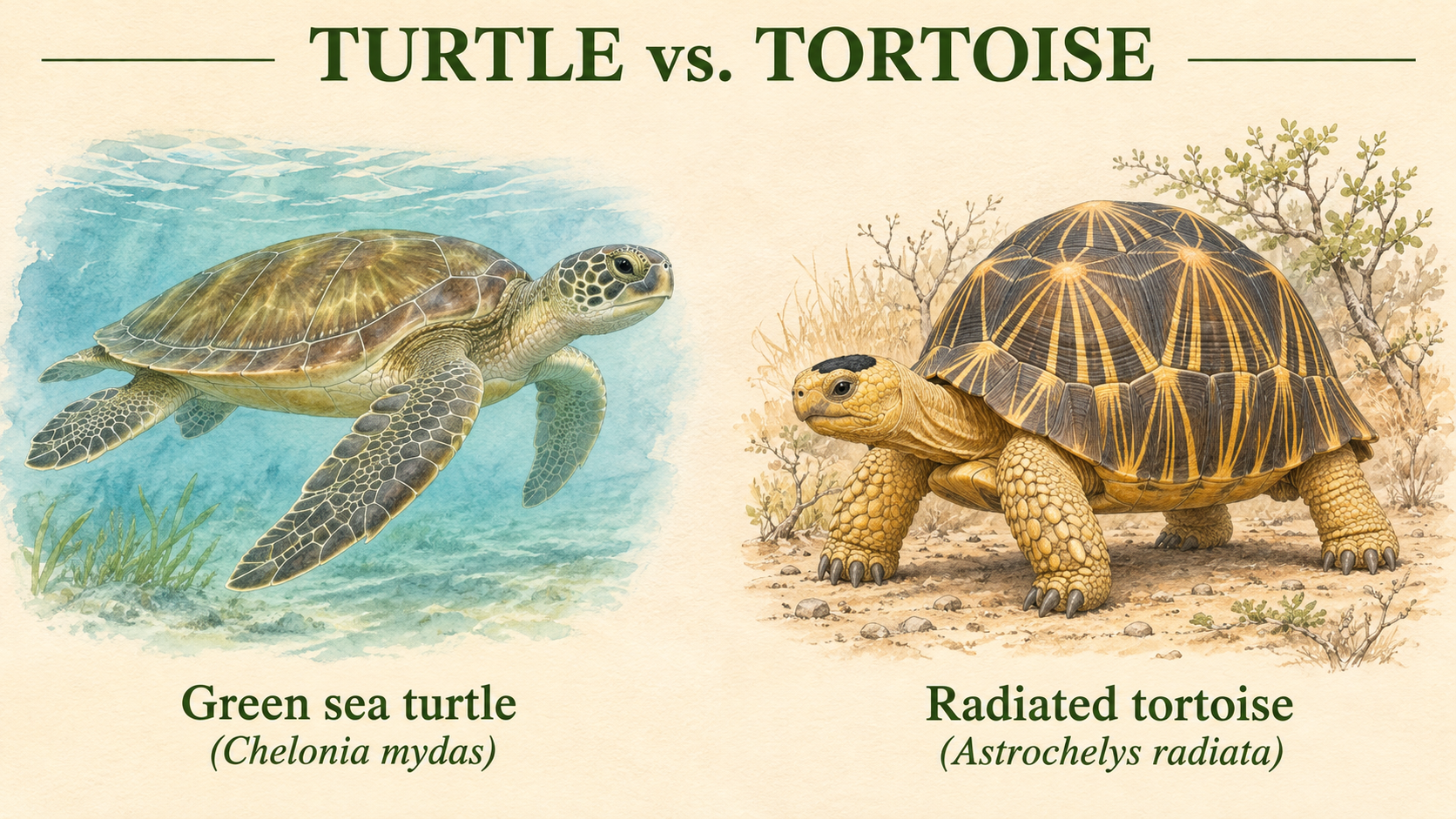
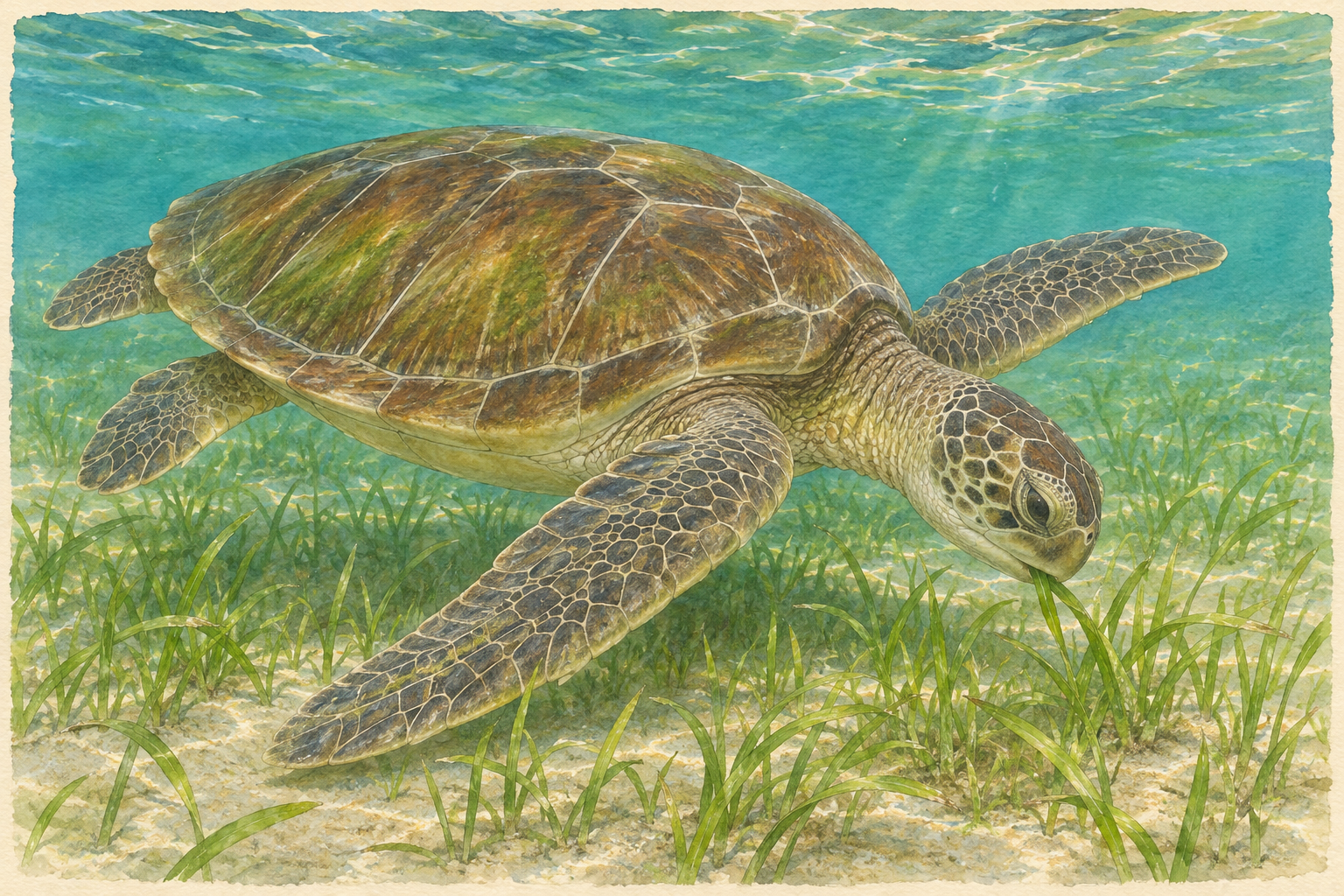
The high dome of a radiated tortoise contrasts with the flatter outline of a swimming green turtle. A radiated tortoise also has striking yellow lines spreading across its dark shell plates. These features make the illustrated pair easy to separate, but they do not provide a universal test for every turtle and tortoise.
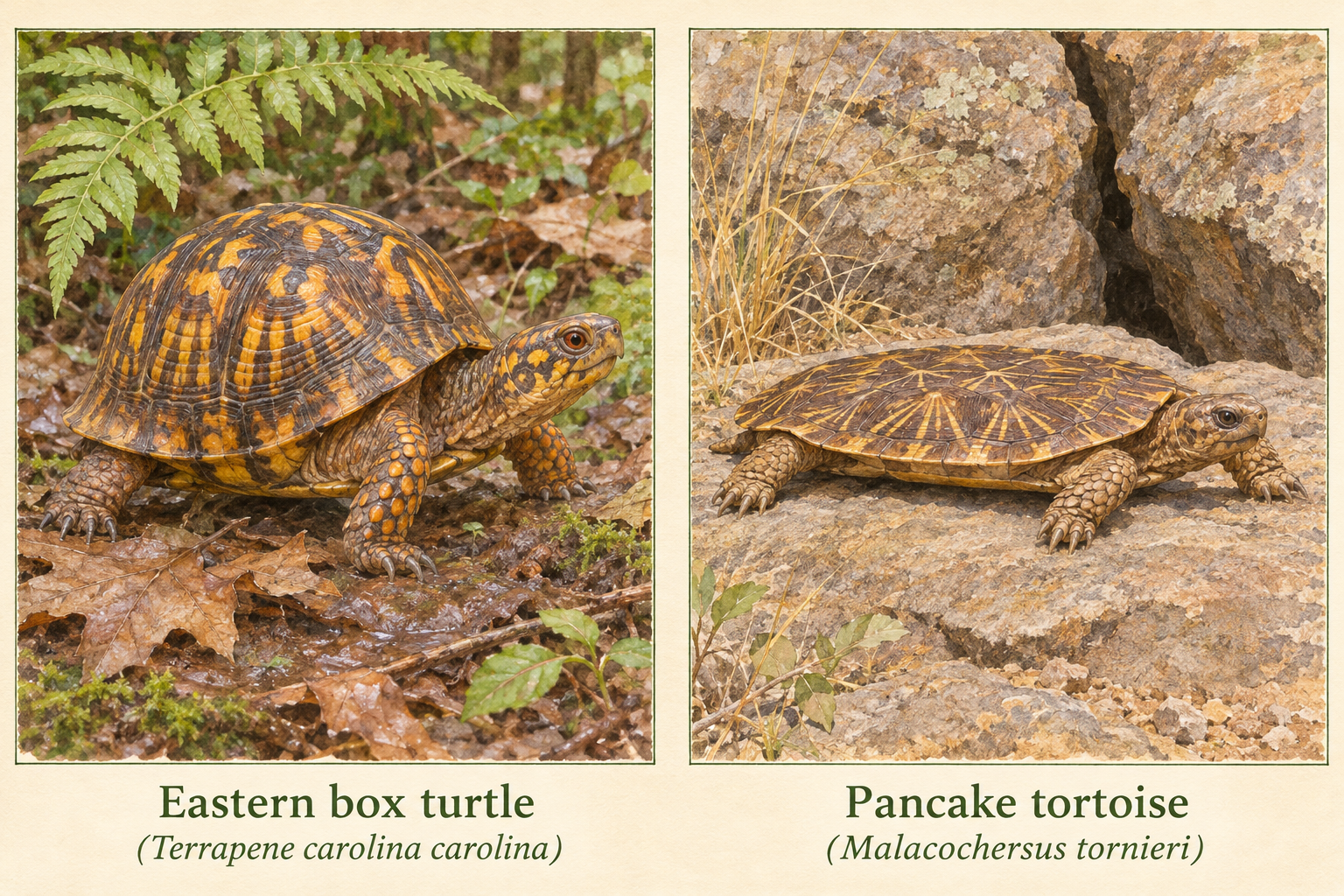
An eastern box turtle is a useful exception. It spends much of its life on land and has a tall, rounded shell, yet it is not a tortoise. Its brown shell carries yellow or orange markings, and a hinge in the lower shell allows it to close up tightly. A domed shell alone therefore cannot settle the name.
The pancake tortoise turns the familiar picture around again. This East African tortoise has an unusually flat, flexible shell that helps it fit into rocky crevices. It belongs to the tortoise family, Testudinidae, despite lacking the heavy dome people often associate with that family.
3. Their Habitats Shape Their Daily Lives
Green turtles spend their lives in marine habitats, with females returning to beaches to nest. Adults commonly feed in shallow areas containing seagrass or algae. They breathe air with lungs, so an animal resting or feeding underwater must eventually come to the surface. Having flippers does not make a sea turtle a fish.
Gopher tortoises show a different set of demands. In the southeastern United States, they occupy dry, sandy uplands where digging is possible. A burrow provides shelter and a more stable retreat from conditions at the surface. The shovel-like forefeet and stout hind feet make sense when viewed beside the entrance to one of these burrows.
Land habitat itself is diverse. Radiated tortoises come from dry woodland and thorny scrub in southern Madagascar. Pancake tortoises use rocky country in East Africa. Eastern box turtles are associated with woodland and nearby open areas, where moisture and shelter remain part of their lives. “Lives on land” is a starting observation, not a complete species identification.
4. Diet Depends on the Species
It is tempting to divide the group into meat-eating turtles and plant-eating tortoises. Green turtles immediately show why that is too simple: adults are largely herbivorous, grazing on seagrass and algae. Younger green turtles have a more mixed diet. Even within one species, food can change as the animal grows.
Radiated tortoises feed on vegetation, including grasses and other available plant material. Pancake tortoises also eat plant foods. Box turtles, by contrast, eat a mixture of animal and plant material. The useful question is therefore what a particular species eats in its habitat, rather than whether its common name contains turtle or tortoise.
5. Both Have a Shell That Is Part of the Body
A shell is not an empty container that a turtle can leave behind. The upper part, called the carapace, is joined to the skeleton; the lower part is the plastron. In many species, keratin plates called scutes cover the outside. The shell of a living tortoise also contains nerves and blood vessels. Its appearance is protective, but it remains living anatomy.
Both aquatic turtles and tortoises lay their eggs on land. Sea turtle nesting is particularly striking because a female leaves her usual watery surroundings to lay eggs on a beach. A life closely tied to water therefore does not mean every stage happens underwater.
Putting the Clues Together
Begin with the limbs, then compare the shell, habitat, and markings. Broad flippers point toward a sea turtle; webbed toes fit many freshwater turtles; stout unwebbed feet support a tortoise identification. If a clue conflicts with the familiar picture, check the species rather than forcing it into a rule. Box turtles and pancake tortoises are good reminders that real animals come with exceptions.
Explore more reptile names in our guide to animals that start with T, or compare another pair of reptiles in Alligator vs. Crocodile.


James Miller grew up on the Oregon coast, exploring tide pools and watching seabirds. He has a particular fondness for owls and keeps a notebook of his bird sightings.
Read More »