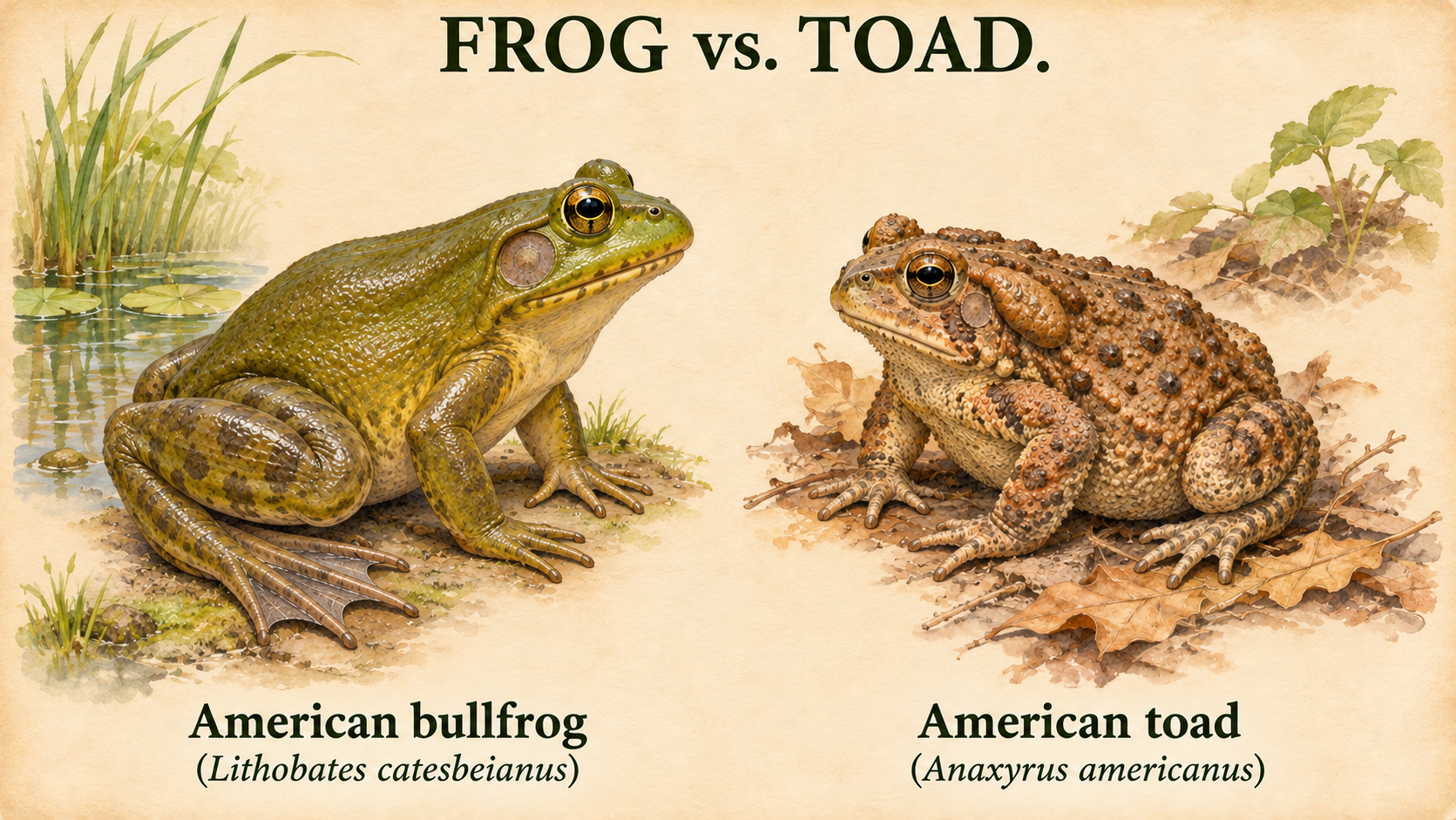
A long-legged amphibian with smooth, moist-looking skin often fits the familiar picture of a frog. A stockier animal with shorter legs and a bumpy skin usually suggests a toad. Those are useful clues, especially when comparing an American bullfrog with an American toad, but they are tendencies rather than rules that work worldwide.
Both belong to the amphibian order Anura. True toads are part of the frog group and belong to the family Bufonidae. The names are therefore uneven: toad describes a particular set of frogs, rather than an entirely separate kind of animal. Common names outside that family can make the distinction less tidy still.
Frog and Toad Clues at a Glance
| Clue | Familiar frog appearance | Familiar toad appearance |
|---|---|---|
| Skin | Often relatively smooth and moist-looking | Often drier-looking and bumpy |
| Build | Frequently longer hind legs | Often stockier, with shorter hind legs |
| Movement | Often long hops or swimming | Often shorter hops or walking |
| Habitat | Many species closely associated with water | Many spend considerable time on land |
| Head glands | Depend on the species | Prominent parotoid glands in many true toads |
| Reliability | Use several traits and a local species guide | Skin texture alone has exceptions |
1. Look at Skin and the Area Behind the Eyes
An American toad has obvious bumps and dark markings on a brown, gray, olive, or reddish background. Its enlarged parotoid glands sit behind the eyes, and bony ridges called cranial crests help distinguish its head. One or two larger warts commonly sit within each dark back spot. These are more specific details than the broad impression that an animal looks rough.
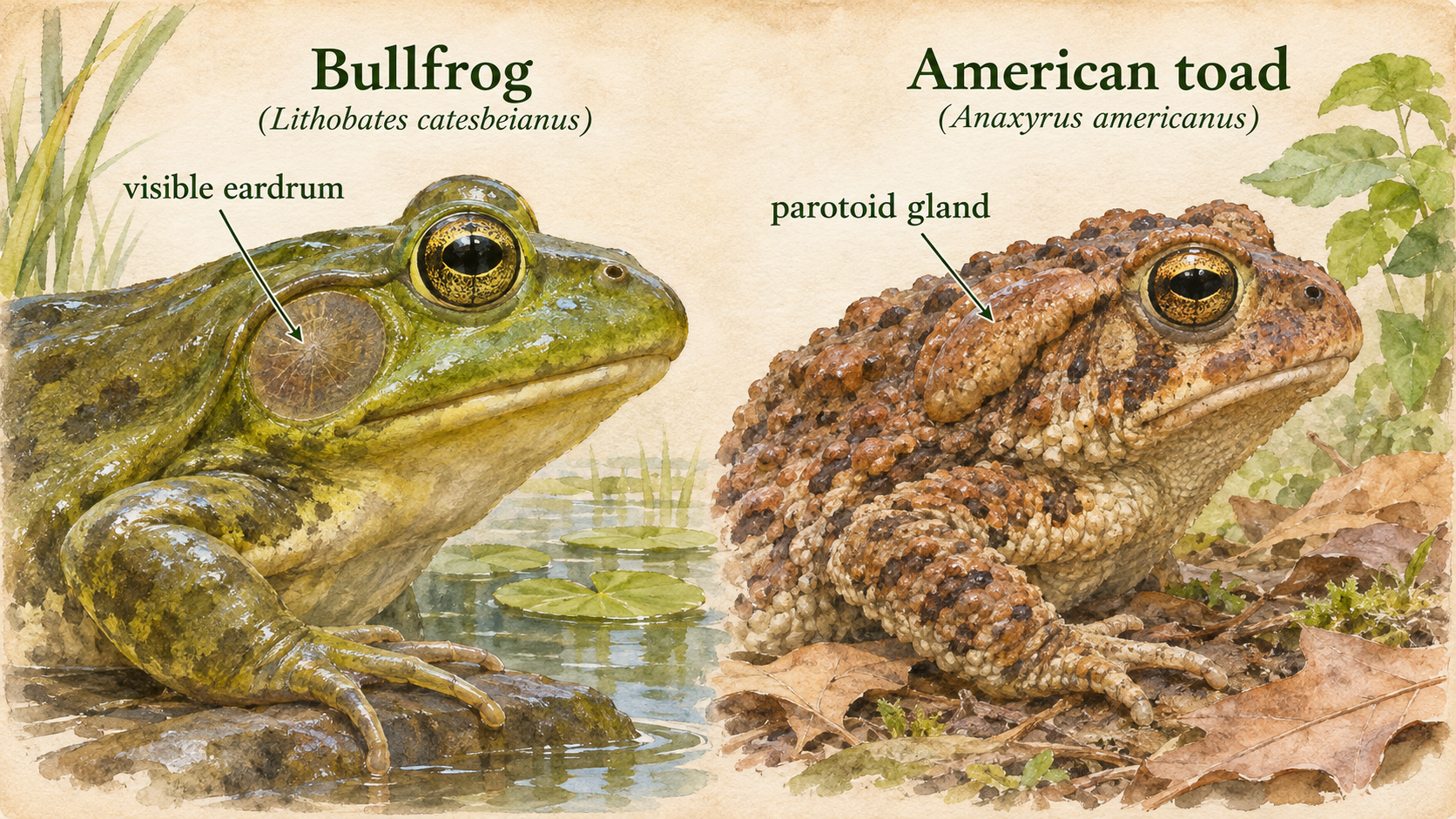
A bullfrog’s conspicuous round disk behind the eye is an external eardrum, or tympanum. Adult males can have a tympanum larger than the eye. Bullfrogs lack the paired ridges that run along the backs of some other familiar frogs; the fold around the eardrum is a separate feature. These details can help move an identification beyond simply “green frog.”
2. Compare the Whole Body and Its Movement
The typical frog has long, folded hind legs suited to powerful hops, while the typical toad is more compact and makes shorter movements. Watching a resting animal can hide much of that difference because its legs are tucked beneath it. A side view or a few moments of ordinary movement often shows the proportions more clearly.
Tree frogs add another body plan. Amazon milk frogs have expanded toe pads that help them grip vegetation and climb. A frog’s limbs may therefore reveal a life in branches rather than a life spent at the edge of a pond. Not every frog is a long-distance jumper, and toe pads are not present on every species.
3. Habitat Is a Clue, Not a Verdict
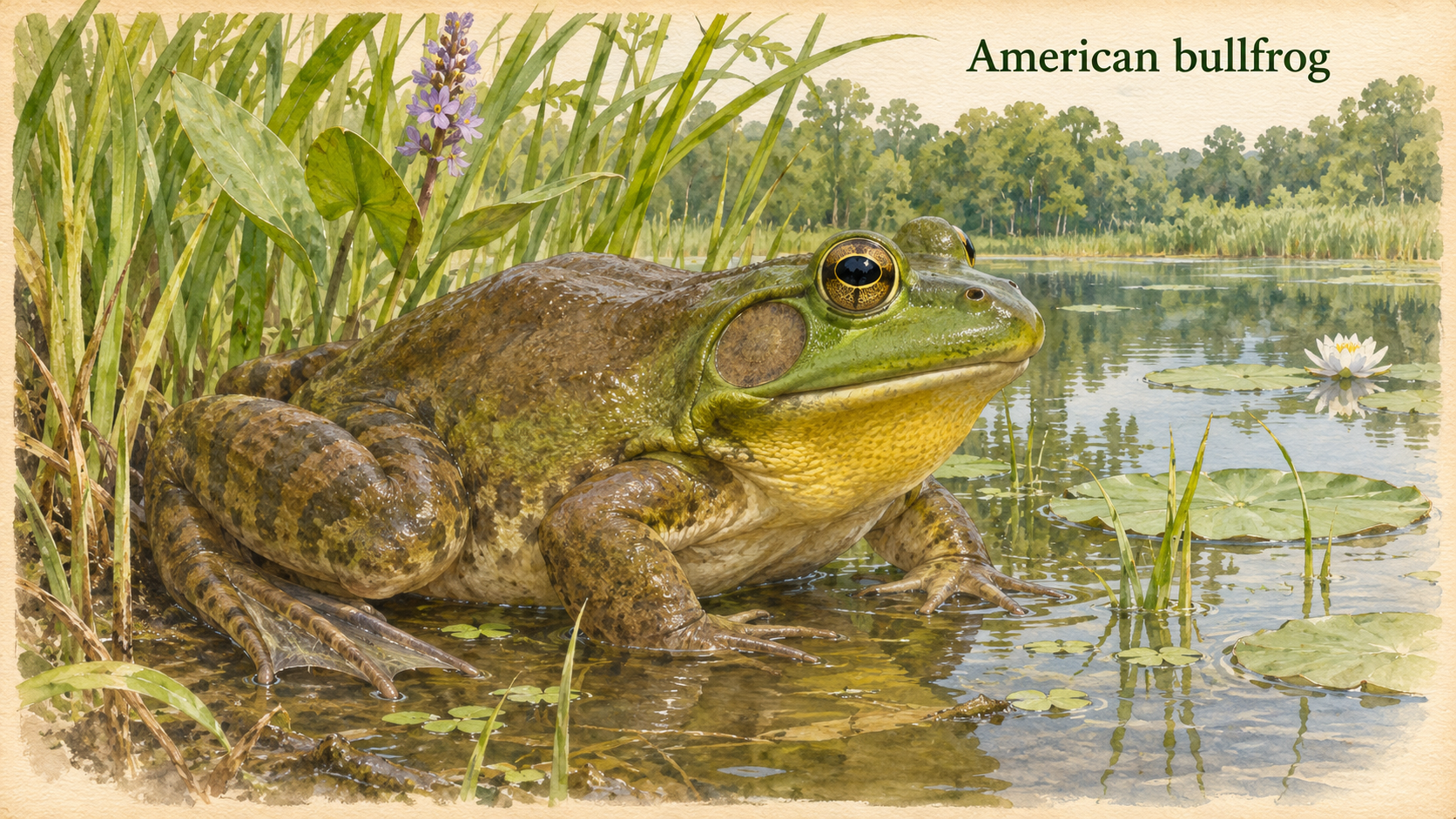
American bullfrogs commonly occupy pond and lake margins, emergent vegetation, and slow-moving waters. Their low calls can be an obvious clue when the animals themselves are hard to see. In Maryland’s field guide, the distinctive bass call is described as sounding like “jug-o-rum.” Location and sound together can be more informative than the color of a distant head.
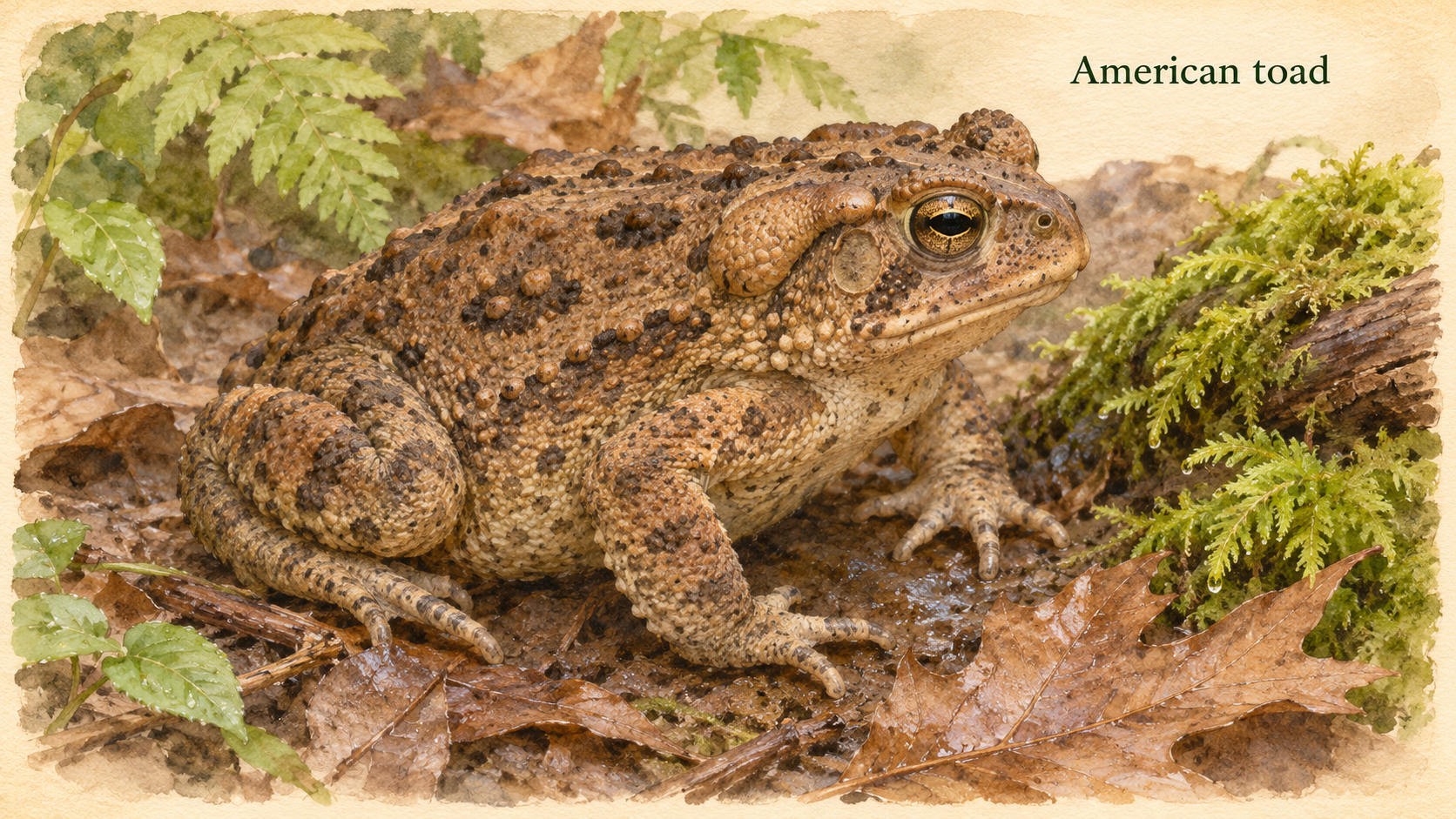
American toads often appear near wetlands during their spring breeding season, then turn up farther from water at other times, including in backyards. Their breeding call is a sustained, high-pitched trill. The contrast with a bullfrog’s deep call is useful for these two species, although it should not become a rule that all frogs sound one way and all toads another.
4. The Exceptions Explain Why Species Matter
The smooth-sided toad has a less warty appearance than the familiar American toad. It lives on the floor of tropical forests in northern South America and belongs to Bufonidae despite its smoother skin. Its reproduction still involves water: eggs and larvae develop in temporary or permanent pools.
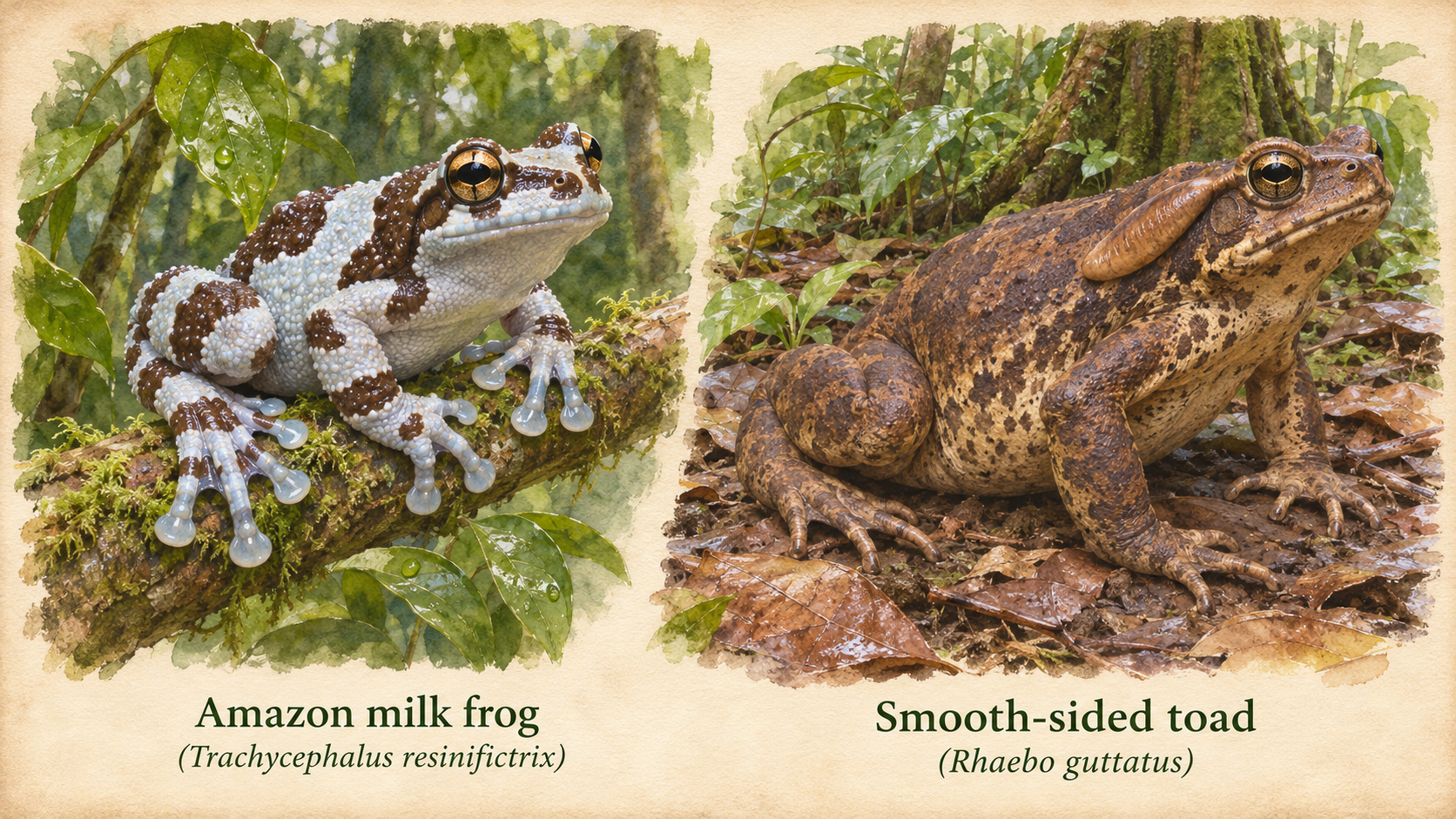
Amazon milk frogs offer a different reminder. Their tree-dwelling life in South American rainforests does not match the simple image of a smooth frog beside open water. Their name comes from a white defensive secretion produced through the skin when threatened. Both this frog and the smooth-sided toad show why a skin-based guess deserves a species check.
Building a Useful Identification
Record the animal’s location, approximate size, skin markings, hind-leg proportions, and any obvious gland or toe-pad features. A distant photograph can preserve those details without moving the animal. Compare them with species known from that area, and include a call recording when available. An unfamiliar species may remain uncertain even when the broader frog or toad appearance is clear.
Explore more amphibian names in our guides to animals that start with F and animals that start with T.


James Miller grew up on the Oregon coast, exploring tide pools and watching seabirds. He has a particular fondness for owls and keeps a notebook of his bird sightings.
Read More »