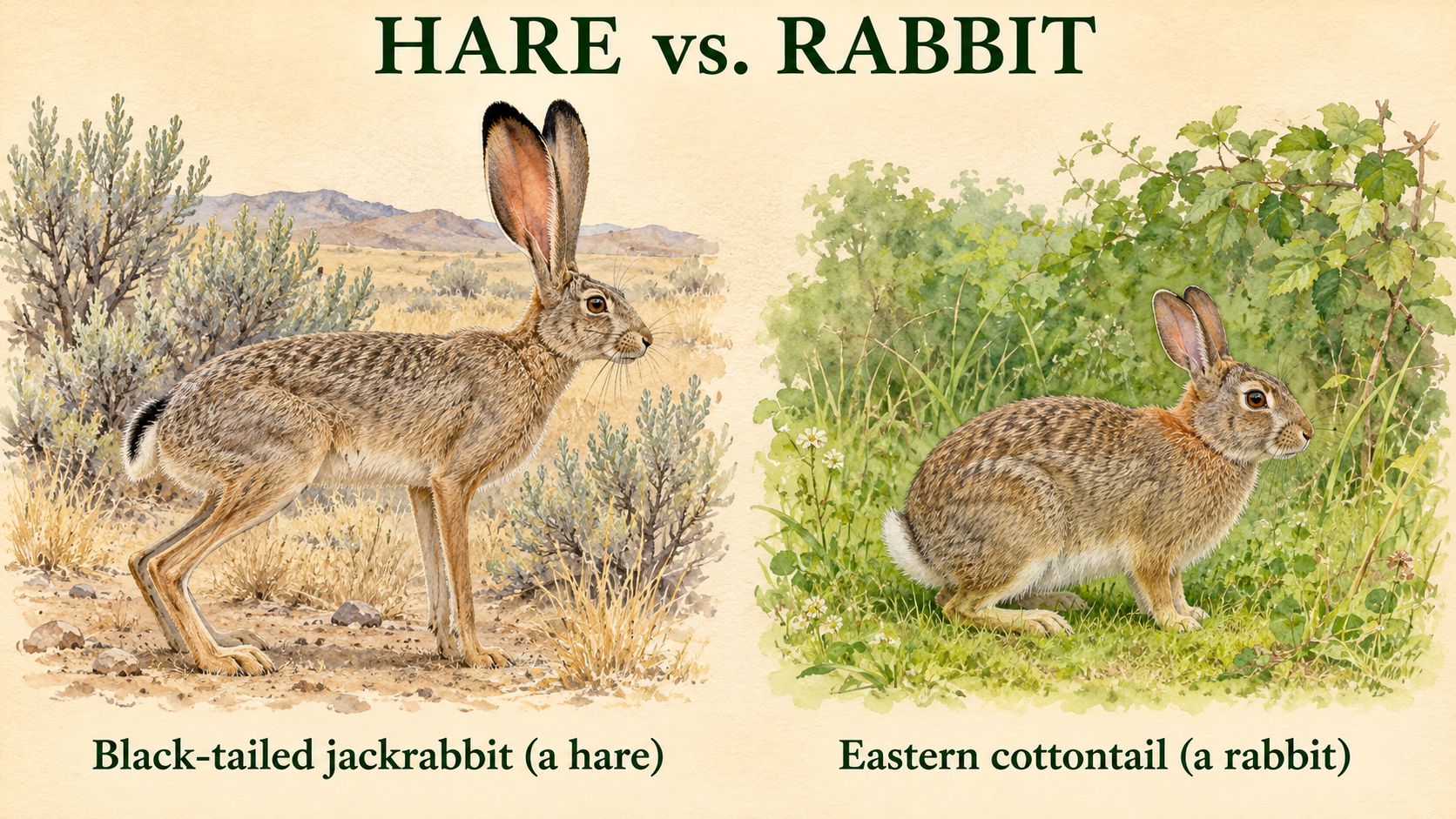
Hares often have longer ears, longer hind legs, and larger feet than the rabbits people commonly see in yards. Their young provide an even stronger biological distinction: a newborn hare is already furred and open-eyed, while a newborn rabbit is much less developed. Names can be misleading, because the animals called jackrabbits are hares.
For a US observer, a black-tailed jackrabbit and an eastern cottontail make a helpful starting comparison. Add a snowshoe hare, however, and it becomes clear that not every hare has enormous jackrabbit ears. Species, habitat, and season all help turn a general impression into a more useful identification.
Hare and Rabbit Differences at a Glance
| Feature | Hares | Rabbits |
|---|---|---|
| Familiar examples | Jackrabbits and snowshoe hares | Cottontails and the European rabbit |
| Body proportions | Often longer-legged with larger feet | Often more compact |
| Ears | Very long in jackrabbits; shorter in snowshoe hares | Usually shorter than a jackrabbit's |
| Newborn condition | Furred, eyes open, mobile relatively soon | Eyes closed and little or no fur |
| Resting and nesting | Sheltered depressions above ground | Depends on species; cottontails nest in shallow ground cups |
| Winter coat | Some species turn white; others remain brown-gray | Cottontails generally retain a brown-gray coat |
1. Look Beyond the Ears
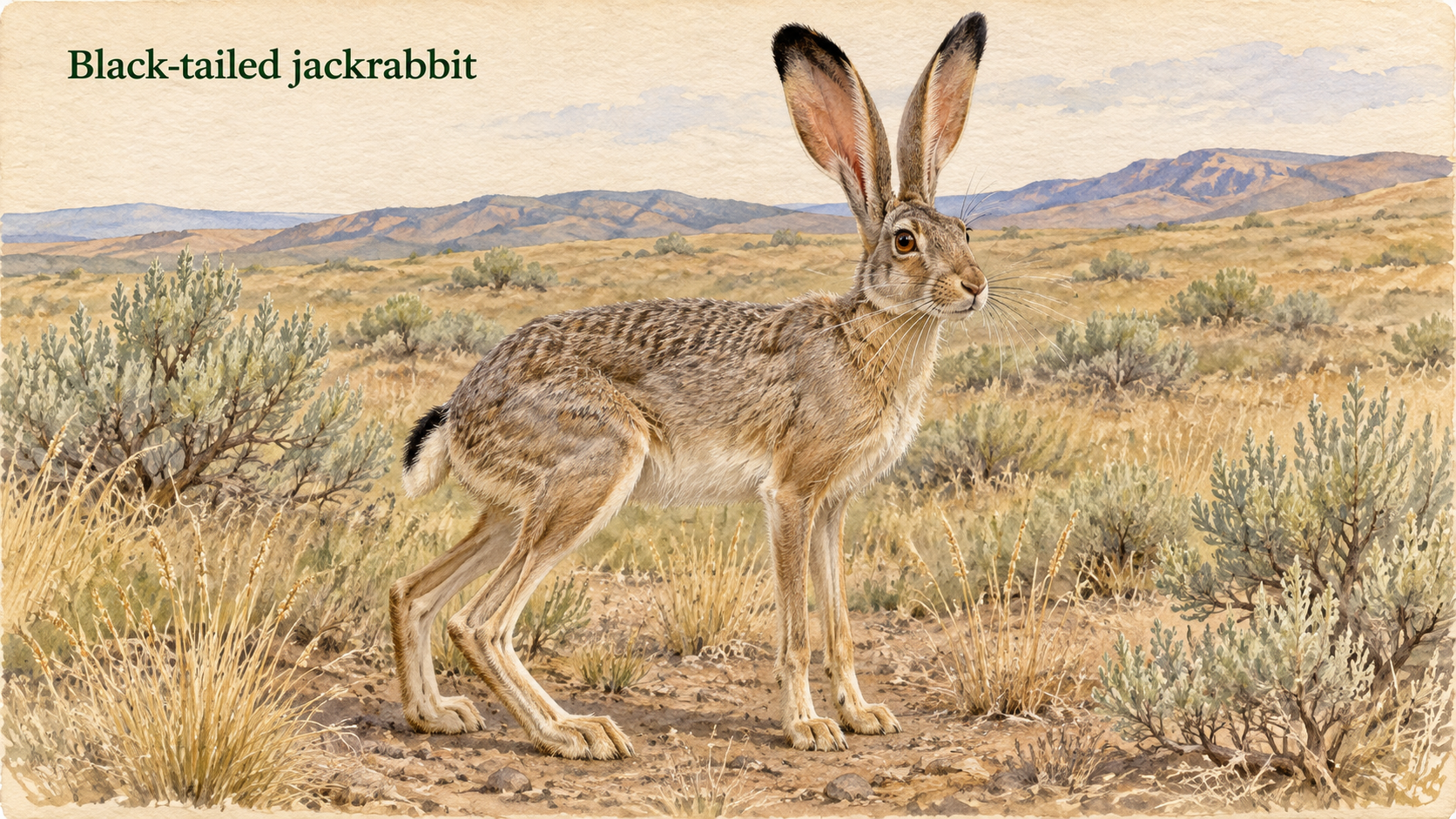
The black-tailed jackrabbit has very long ears with dark tips, a lean body, long hind legs, and a dark stripe along the upper side of its tail. Its shape is well suited to the open, sparsely vegetated western landscapes where it lives. A crouching animal can hide much of the hind-leg length, so look at the whole body rather than judging one still pose.
An eastern cottontail has a more rounded appearance, gray-brown fur, a rusty patch at the back of the neck, and a short tail with a conspicuous white underside. Its ears are still long compared with those of many mammals, but they lack the extreme proportions of a jackrabbit. Size alone is less useful when distance, age, or a poor viewing angle makes the comparison uncertain.
2. Newborn Young Start Life Differently
Biologists describe hare young as precocial: they are relatively developed when born, with fur and open eyes, and can move about soon afterward. Rabbit young are altricial, meaning they arrive at a more dependent stage. Eastern cottontail kits are born with their eyes closed and little or no fur, in a nest lined with grass and the mother’s hair.
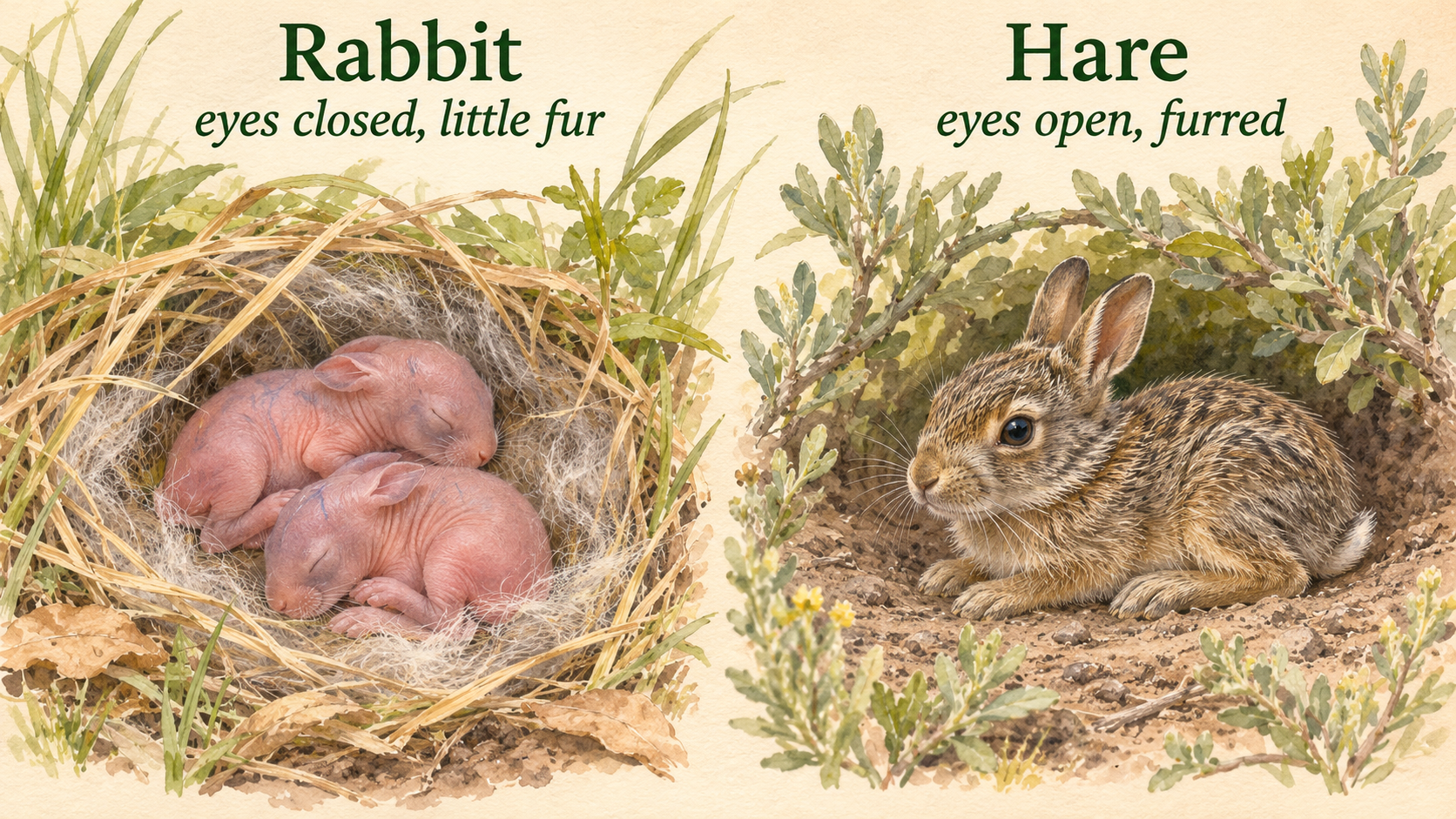
This difference does not mean a young hare has no further need for its mother. It describes its condition at birth. Nor does an open-eyed animal automatically have to be a hare: rabbit kits develop fur and open their eyes as they grow. The age of the animal is essential when interpreting a photograph of young wildlife.
3. Not Every Rabbit Lives in an Underground Warren
The familiar picture of rabbits in a connected burrow system does not describe every rabbit species. An eastern cottontail’s nest is a shallow depression at ground level, lined and covered with grasses and fur. Such a nest can be concealed in a lawn or garden. It is not the elaborate underground home that the word rabbit sometimes brings to mind.
A mother cottontail spends much of her time away from the nest and returns for brief nursing visits. That behavior makes the nest less conspicuous to predators. An apparently unattended nest can therefore be part of a normal routine. Observing from a distance is more informative than uncovering or repeatedly approaching the young.
4. Habitat Helps Explain Their Habits
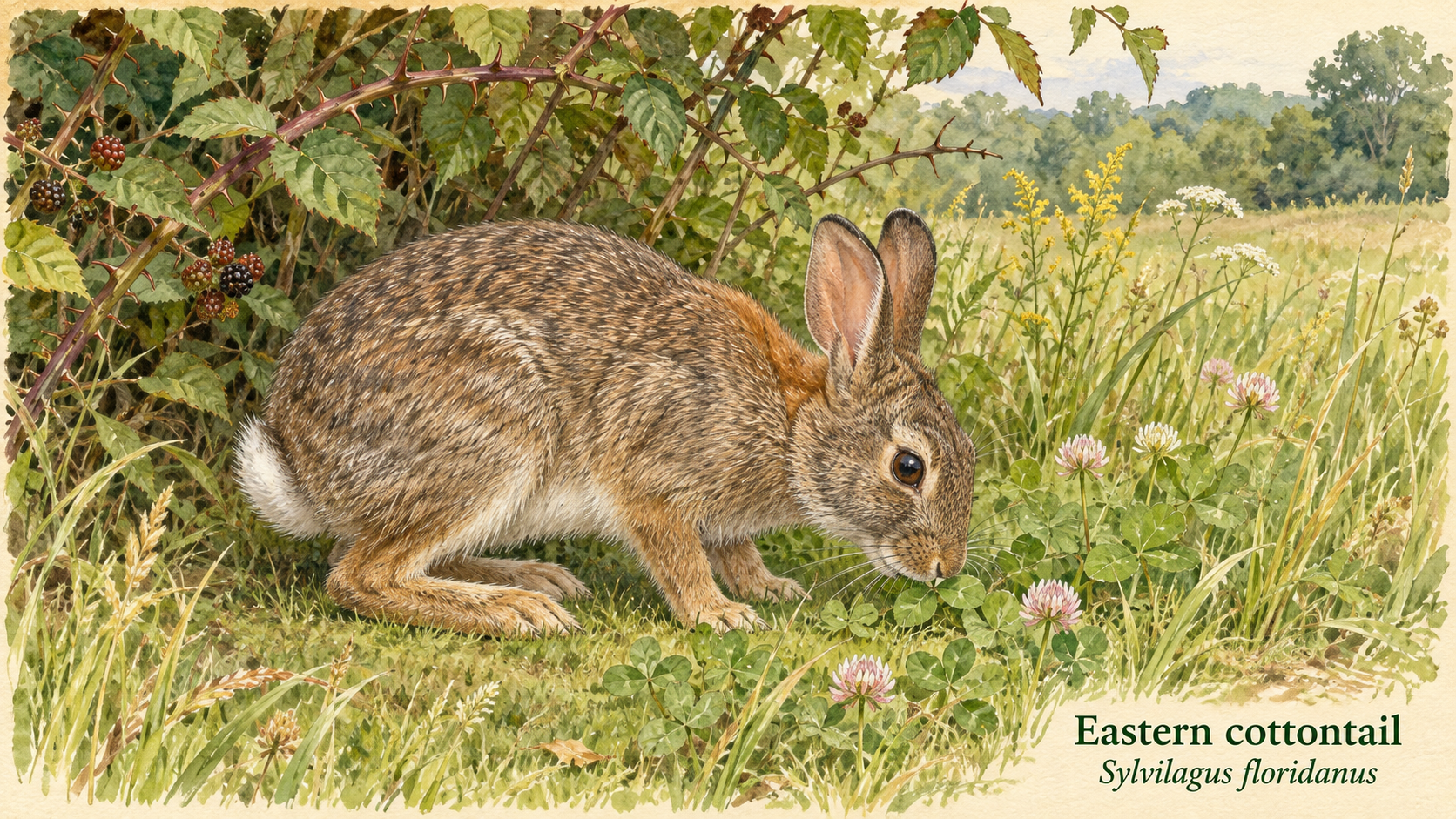
Eastern cottontails use brushy cover in woodlots, field edges, and suburban plantings. Grasses and clover are important summer foods, with twigs and bark becoming more useful in winter. A small animal slipping from an open feeding patch into thick cover fits this habitat pattern, although a close look is still needed to determine its species.
Black-tailed jackrabbits are associated with more open country, including prairie, shrubland, and semi-arid desert. Snowshoe hares show why “hare means open grassland” is too broad: they use dense northern woodland and mountain thickets. Their broad, furry hind feet help support them on soft snow.
5. Some Hares Change Color with the Seasons
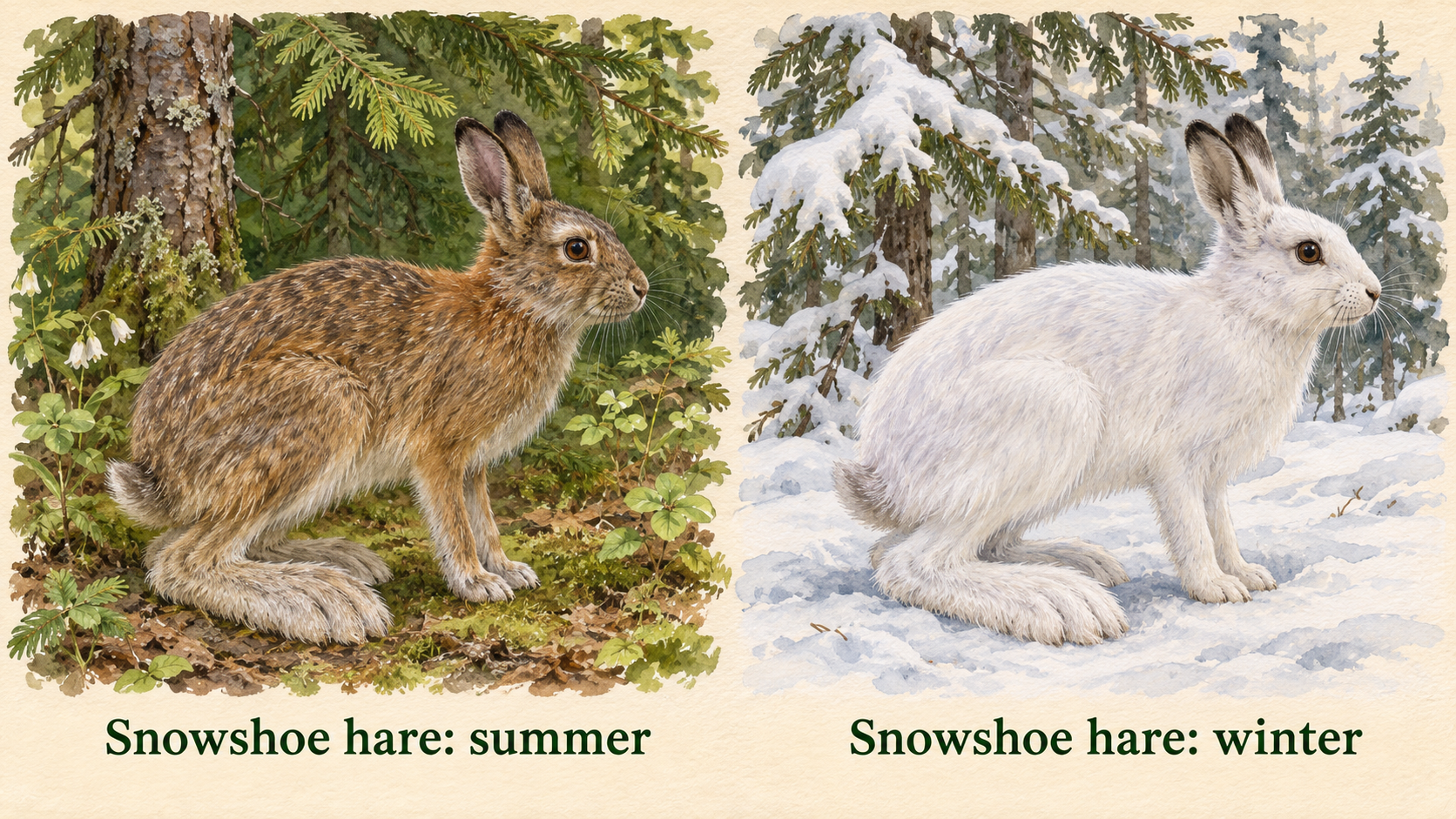
In Minnesota, a snowshoe hare grows a white winter coat after its brown summer coat. That seasonal contrast can be striking, but color should still be interpreted with location and species in mind. A black-tailed jackrabbit retains a brown-gray appearance through the year. White-tailed jackrabbits provide another hare example with a pale winter coat.
For identification, begin with the ears, hind feet, tail, and body shape, then check what lives in the area. A rabbit and a hare may share long ears and a bounding gait while differing in species, shelter, and development. The jackrabbit’s name is a useful reminder that a common name is only the beginning.
Discover more mammal names in our guides to animals that start with H and animals that start with R.


James Miller grew up on the Oregon coast, exploring tide pools and watching seabirds. He has a particular fondness for owls and keeps a notebook of his bird sightings.
Read More »