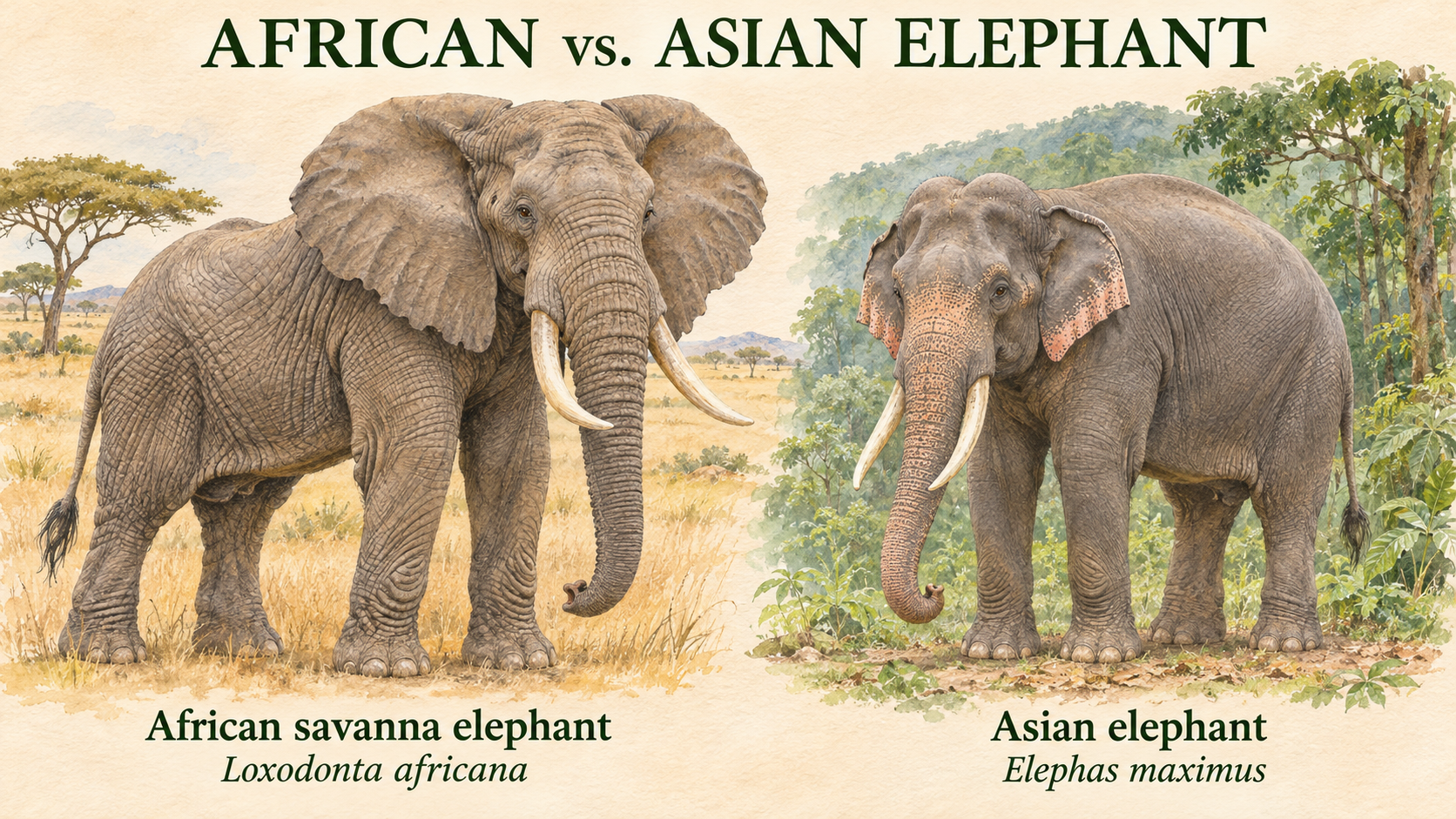
Ears are a useful first clue when comparing African and Asian elephants. African elephants generally have larger ears, while Asian elephants have smaller, more rounded ears. The tip of the trunk provides another distinction: African elephants have two finger-like projections, and Asian elephants have one. Tusks and body shape add context, but need more qualification.
There are three living elephant species. Africa has the savanna or bush elephant, Loxodonta africana, and the forest elephant, Loxodonta cyclotis. Asia has Elephas maximus. The familiar photograph of an enormous, wide-eared African elephant often shows the savanna species, so it should not stand in for every African elephant feature.
African and Asian Elephant Clues at a Glance
| Feature | African elephants | Asian elephant |
|---|---|---|
| Living species | Savanna elephant and forest elephant | Asian elephant |
| Ears | Generally larger; shape differs between the African species | Smaller, more rounded ears |
| Trunk tip | Two opposing finger-like projections | One finger-like projection |
| Visible tusks | Generally occur in males and females, with exceptions | Develop in some males; females lack large visible tusks |
| Back outline | Often flatter or more concave in the familiar savanna comparison | Often more rounded or arched |
| Size context | Savanna elephant is the largest; forest elephant is smaller than its savanna relative | Size varies with sex, age, and population |
| Native setting | African savannas, woodlands, and forests, depending on species | South and Southeast Asian forests, grasslands, and associated habitats |
1. Compare Ears in Proportion to the Head
The broad ear flaps of an African savanna elephant are especially conspicuous. An Asian elephant’s ears occupy a smaller area beside the head and usually have a rounder outline. Look at a relaxed side or three-quarter view where the ear is visible; a folded-back ear can conceal much of its shape.
Elephant ears also help release heat. They contain many blood vessels, and moving the ears helps cool circulating blood. Asian elephants use their ears this way too. The size difference is an identification clue, rather than a reason to assume that only the African animals use their ears for temperature control.
2. The Trunk Tips Have Different Grips
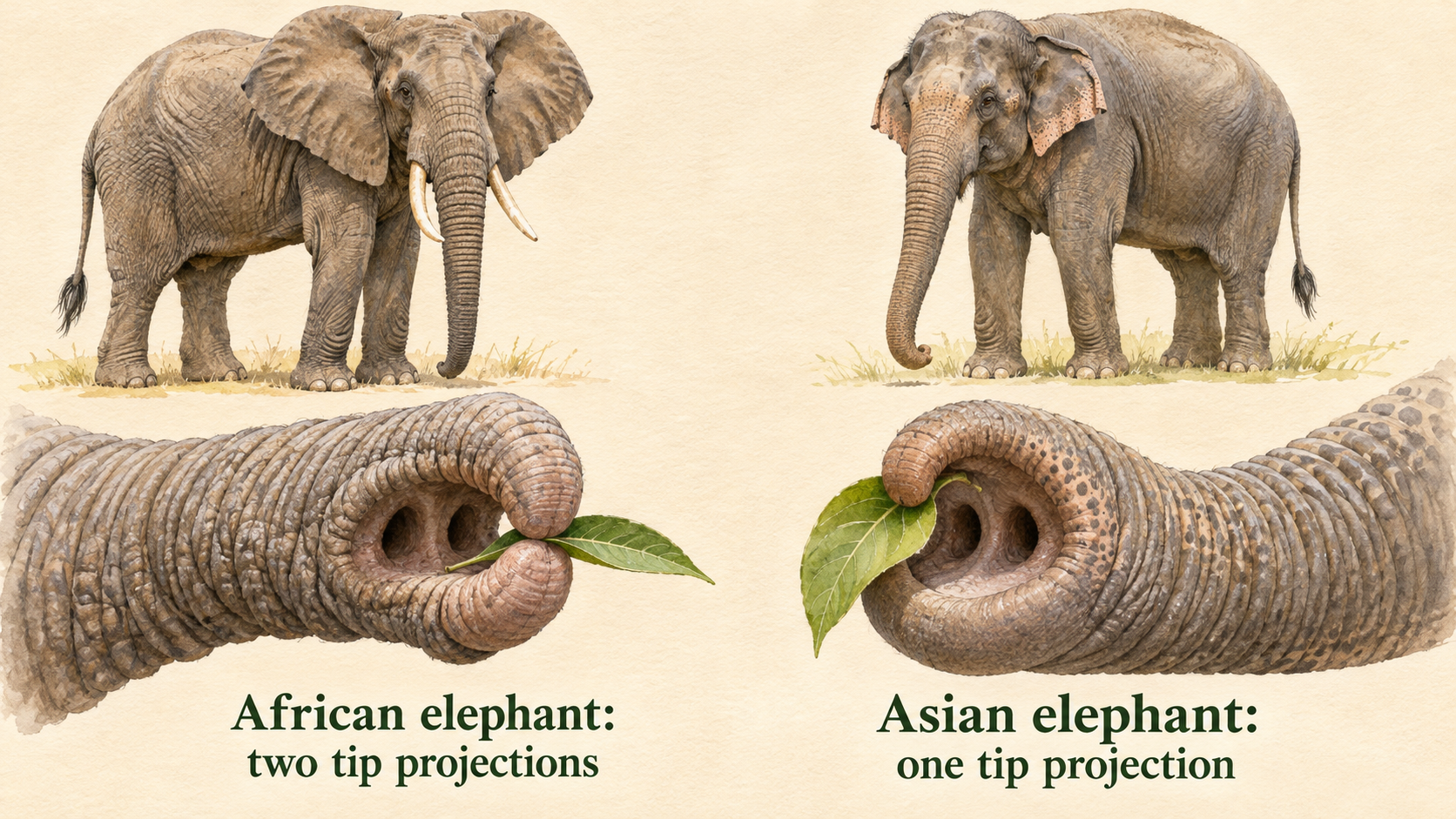
African elephants have two small projections at the trunk tip that can oppose one another when grasping an object. Asian elephants have one projection and can curl the trunk tip around what they are picking up. The difference is structural, even though all three species use the trunk for many similar tasks.
A trunk can gather food, smell, touch, lift, and draw up water that the elephant then pours into its mouth. Its movements are varied and precise. A distant trunk held downward may hide the tip completely, so this excellent anatomical clue is not always available during an ordinary sighting.
3. Tusks Depend on Species, Sex, and the Individual
African elephants generally develop tusks in both sexes, although some individuals lack them. Among Asian elephants, large visible tusks occur in some males, while females have much smaller tusks, sometimes called tushes, that are not conspicuous in the same way. A tuskless animal therefore cannot be identified as Asian from that feature alone.
Tusks are enlarged incisor teeth. Elephants use them in activities such as digging and stripping bark, alongside their trunks and feet. Their presence is more informative when the observer also knows the animal’s age and sex and can compare its ears, back, and trunk tip.
4. Africa’s Two Species Need Their Own Comparison
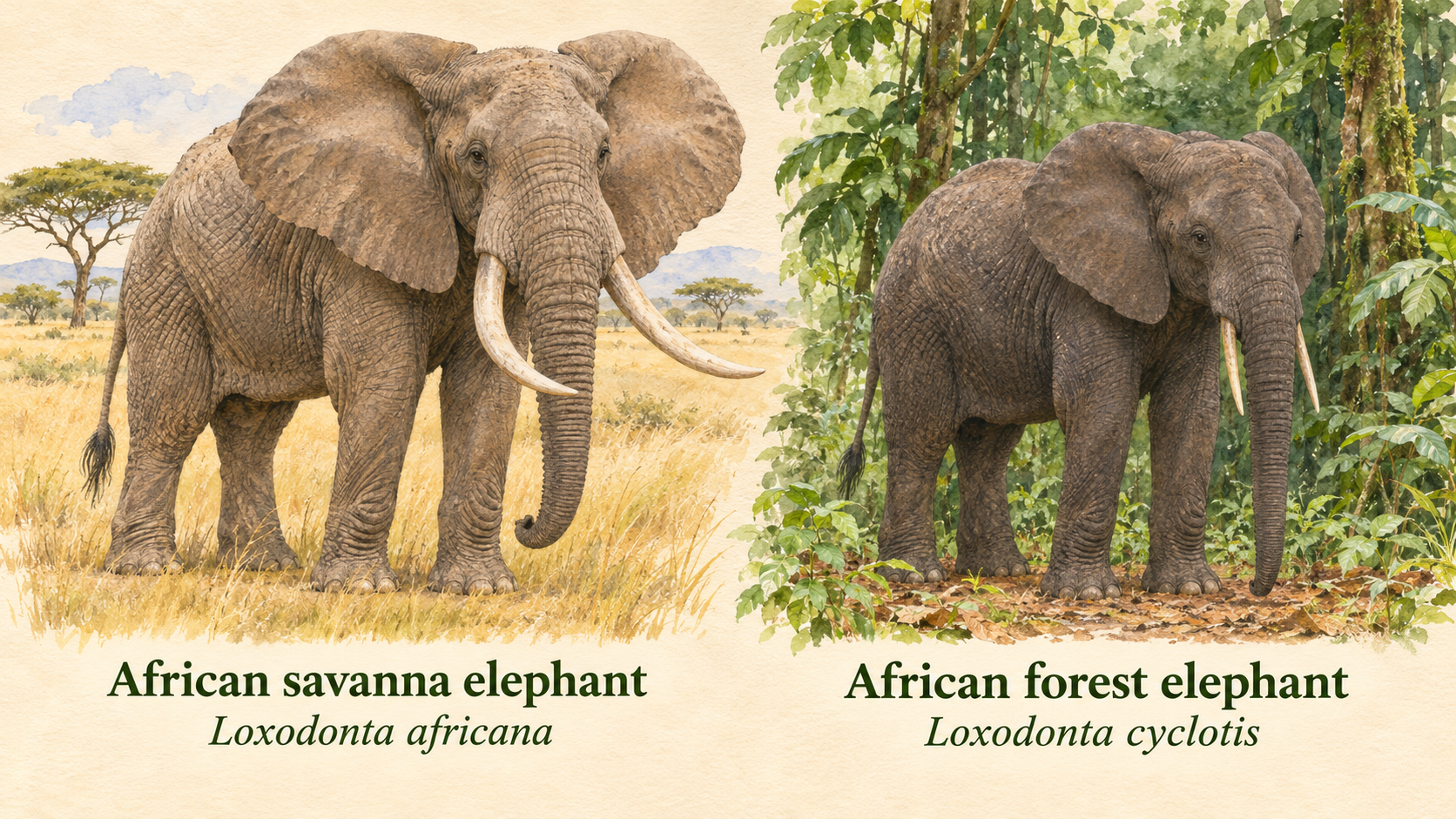
African forest elephants live in the dense tropical forests of West and Central Africa. Compared with savanna elephants, they are smaller, have more oval or rounded ears, and carry straighter tusks that point downward. Savanna elephant tusks generally curve farther outward, and the ears have the broader fan-like outline familiar from grassland scenes.
Recognizing these as separate species makes the African-versus-Asian comparison more accurate. The two African animals share the two-projection trunk tip, but differ in other visible features. Size alone is a poor substitute for the combination of ear shape, tusks, body proportions, and a known species background.
5. Habitat Adds Context to the Anatomy
Asian elephants use forests and landscapes that include grassy openings and other feeding areas across South and Southeast Asia. They eat plant foods such as grasses, leaves, bark, roots, twigs, and fruit. Their daily movements follow the need for food, water, and suitable conditions, rather than staying within one uniform kind of forest.
African savanna elephants are associated with savannas and woodlands, while forest elephants have a different setting in dense rainforest. A habitat label can narrow the possibilities, but a captive photograph may provide no natural range clue at all. Visible anatomy is still needed when the background is unknown.
For a practical identification, start with the ears, then use the trunk tip when visible. Treat tusks and apparent size as supporting evidence, and remember that African includes two species. Explore more names in our guide to animals that start with E.


James Miller grew up on the Oregon coast, exploring tide pools and watching seabirds. He has a particular fondness for owls and keeps a notebook of his bird sightings.
Read More »