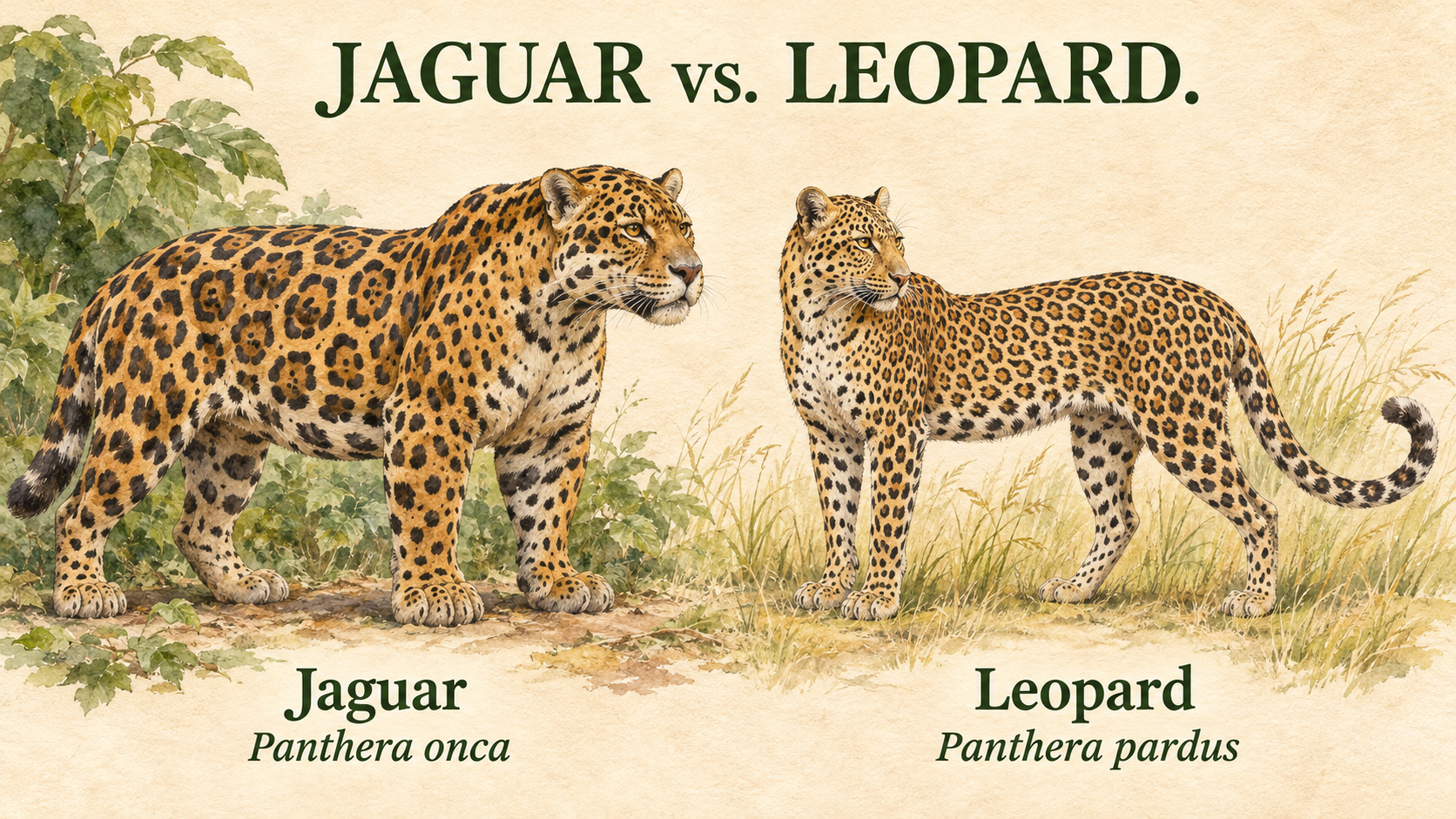
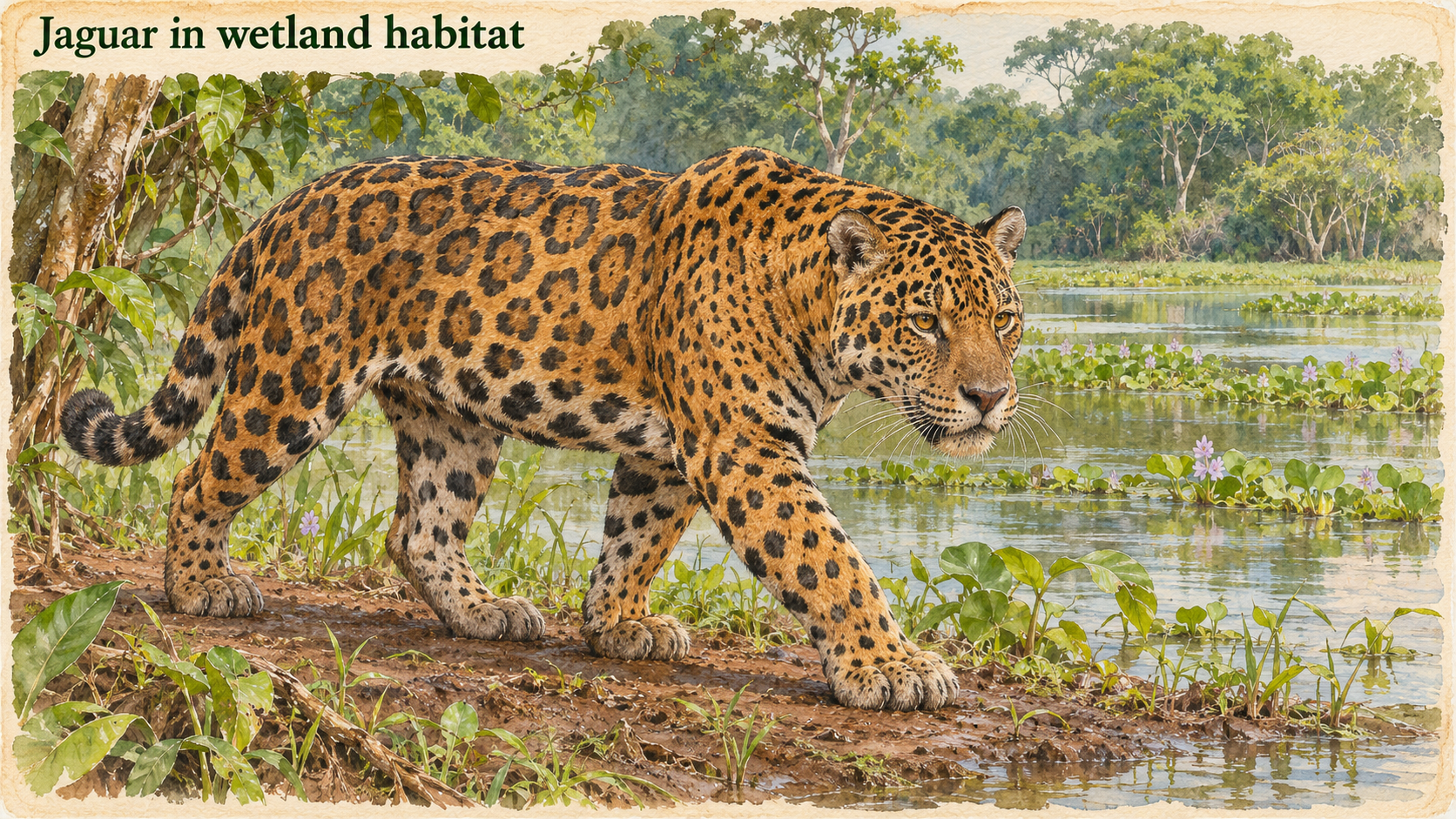
Look closely at the rosettes on a jaguar’s side and you will often see small black spots inside the larger dark rings. A leopard’s rosettes usually have unspotted centers. Combine that pattern with a jaguar’s stockier body and broader head, or a leopard’s leaner build and longer tail, and the comparison becomes much clearer.
Location is another major clue. Jaguars are native to the Americas, while leopards are native to Africa and Asia. The two cats can look remarkably similar in a photograph without background information, but they occupy different parts of the world. Their scientific names are Panthera onca and Panthera pardus, respectively.
Jaguar and Leopard Differences at a Glance
| Feature | Jaguar | Leopard |
|---|---|---|
| Native region | The Americas | Africa and Asia |
| Flank rosettes | Often large and blocky, with small spots inside | Usually smaller and more densely packed, with unspotted centers |
| Build | Generally stockier and more heavily muscled | Generally leaner and more lithe |
| Head | Broad, with powerful jaws | Usually narrower and less massive |
| Tail | Relatively shorter | Relatively long, useful in balancing |
| Habitats | Includes forests, wetlands, and other landscapes | Includes forests, savannas, mountains, and other landscapes |
| Dark forms | Melanistic individuals occur | Melanistic individuals occur too |
1. Compare Rosettes on the Flanks
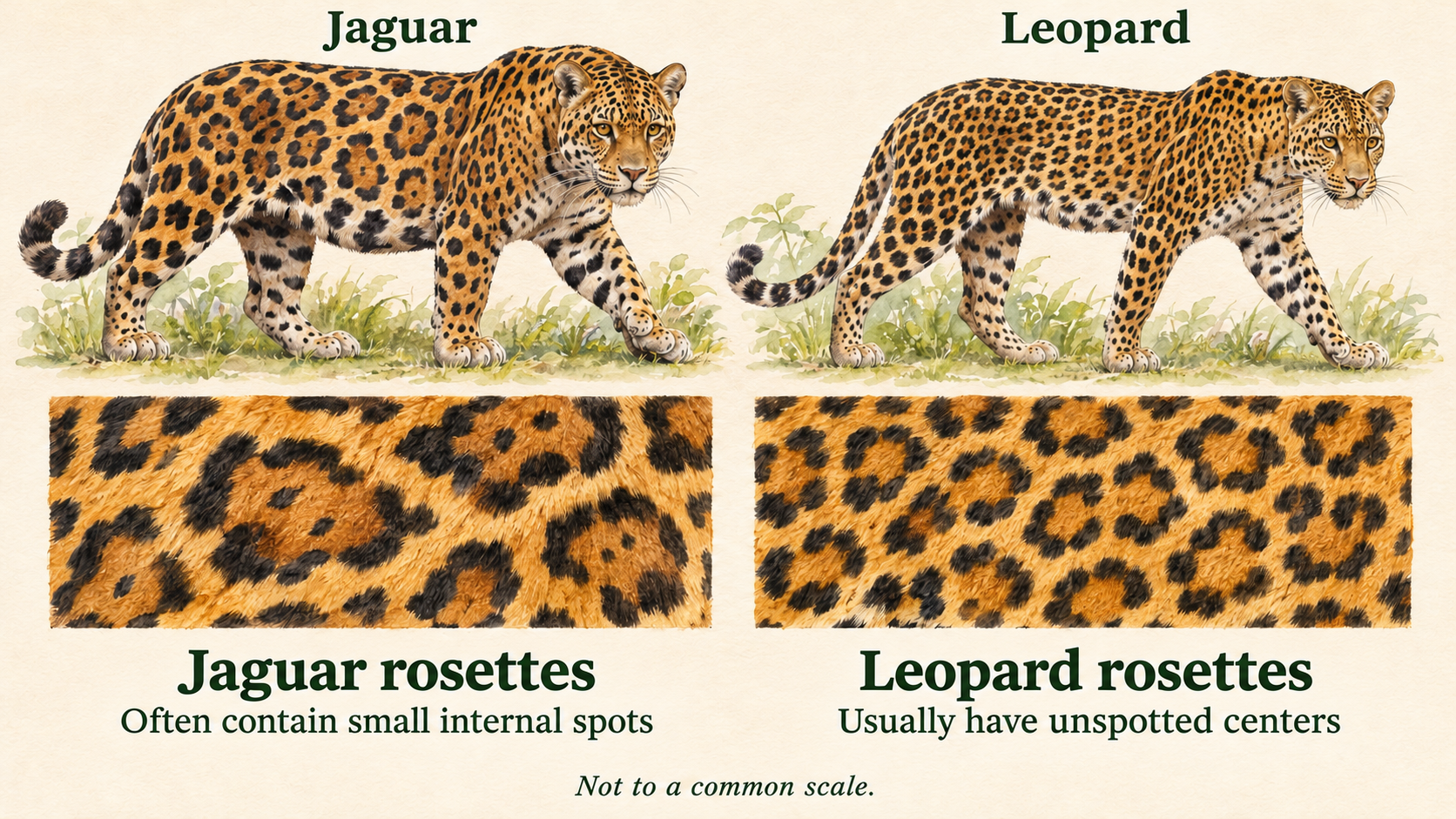
A rosette is a cluster or ring-like arrangement of dark marks surrounding a differently colored center. Jaguar rosettes are often irregular and blocky, with a brownish interior and one or more smaller black marks inside. Leopard rosettes tend to form tighter clusters around a center without those internal dots.
Use a view of the flank rather than expecting every mark on the animal to follow the same pattern. Both species also have solid dark spots, particularly on parts of the head and limbs. Individual markings vary, and fur, shadow, or a blurred image can obscure the centers. One isolated spot is much weaker evidence than a clear stretch of the coat.
2. Look at the Head and Overall Build
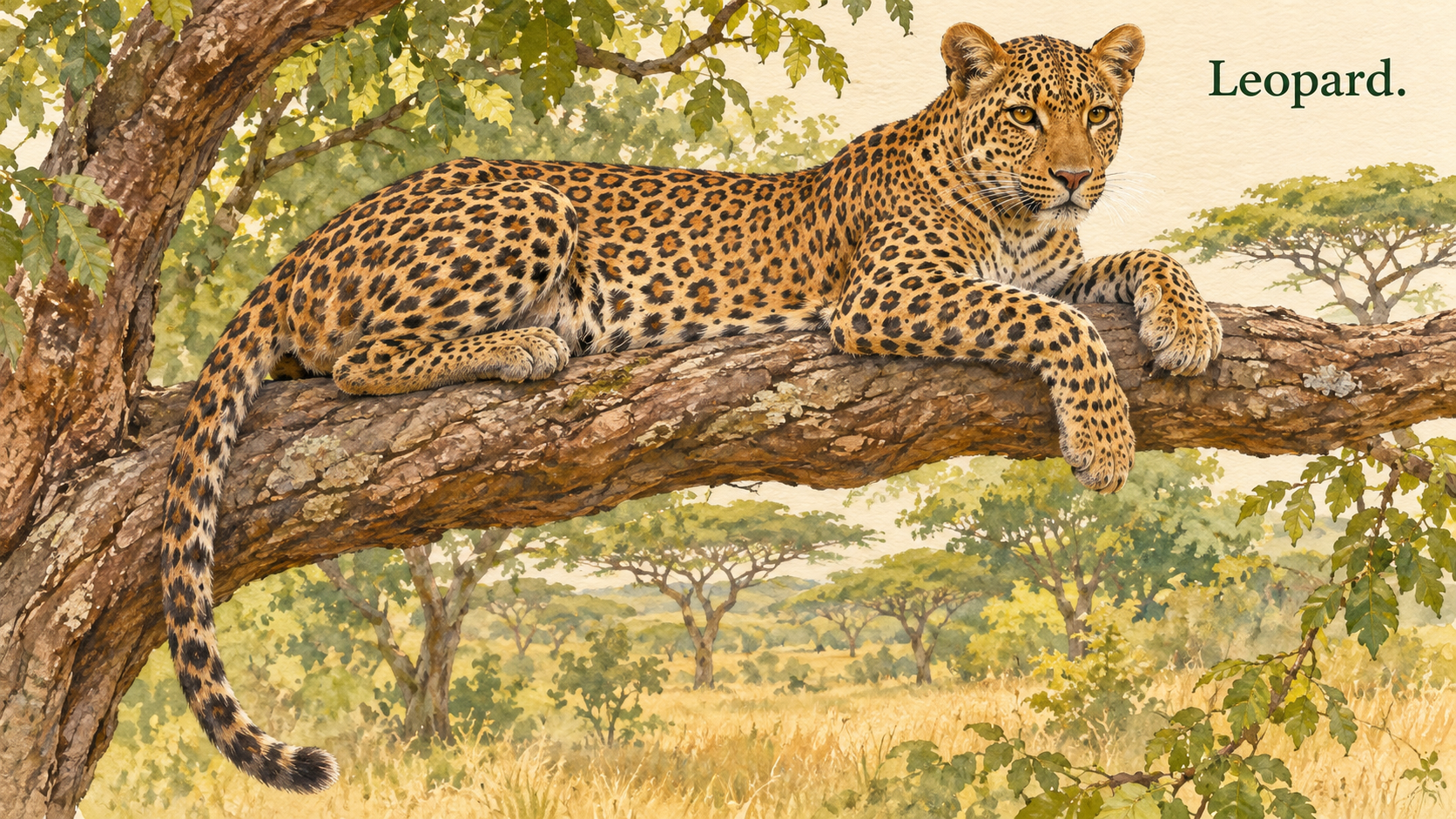
Jaguars are typically broad-headed and heavily muscled, with a compact, powerful appearance. Leopards usually look leaner and carry a longer tail. These are proportional differences rather than a fixed rule that every jaguar must outweigh every leopard. Sex, age, and the angle of a photograph can all affect the impression.
A useful comparison includes the whole animal: head, shoulders, torso, legs, and tail. If a photograph only shows the face, important clues are missing. A cat crouching in dense vegetation can also look shorter and broader than the same animal standing in an unobstructed side view.
3. Native Range Separates Them More Clearly Than Scenery
A forest background alone does not distinguish the species, because both use forest habitat. Jaguars are strongly associated with rivers, wetlands, and tropical forests, yet they also occur in other kinds of landscape. Brazil’s Pantanal is a famous wetland example. The cat’s muscular limbs and large paws suit movement over ground and through water.
Leopards occupy a wide variety of African and Asian habitats, from wooded savanna to rainforest and mountain terrain. They climb readily and may rest in trees. Their long tails help with balance on branches. Knowing the country or region where a wild animal was observed is therefore more decisive than a generic label such as “jungle cat.”
4. Their Hunting Skills Reflect Different Opportunities
Both cats stalk and ambush prey. Jaguars have especially powerful jaws and can take prey that includes capybaras, peccaries, and reptiles. Leopards hunt a wide range of animals too, and are well known for carrying food into trees where competing predators have more difficulty reaching it. These behaviors explain useful ecological differences without turning either cat into a single-prey specialist.
Neither a swimming cat nor a cat in a tree should be identified from the behavior alone. Jaguars can climb, and leopards can swim. Body proportions, flank pattern, and native range give a firmer foundation than the setting of one dramatic picture.
5. A Black Panther Can Be Either Species
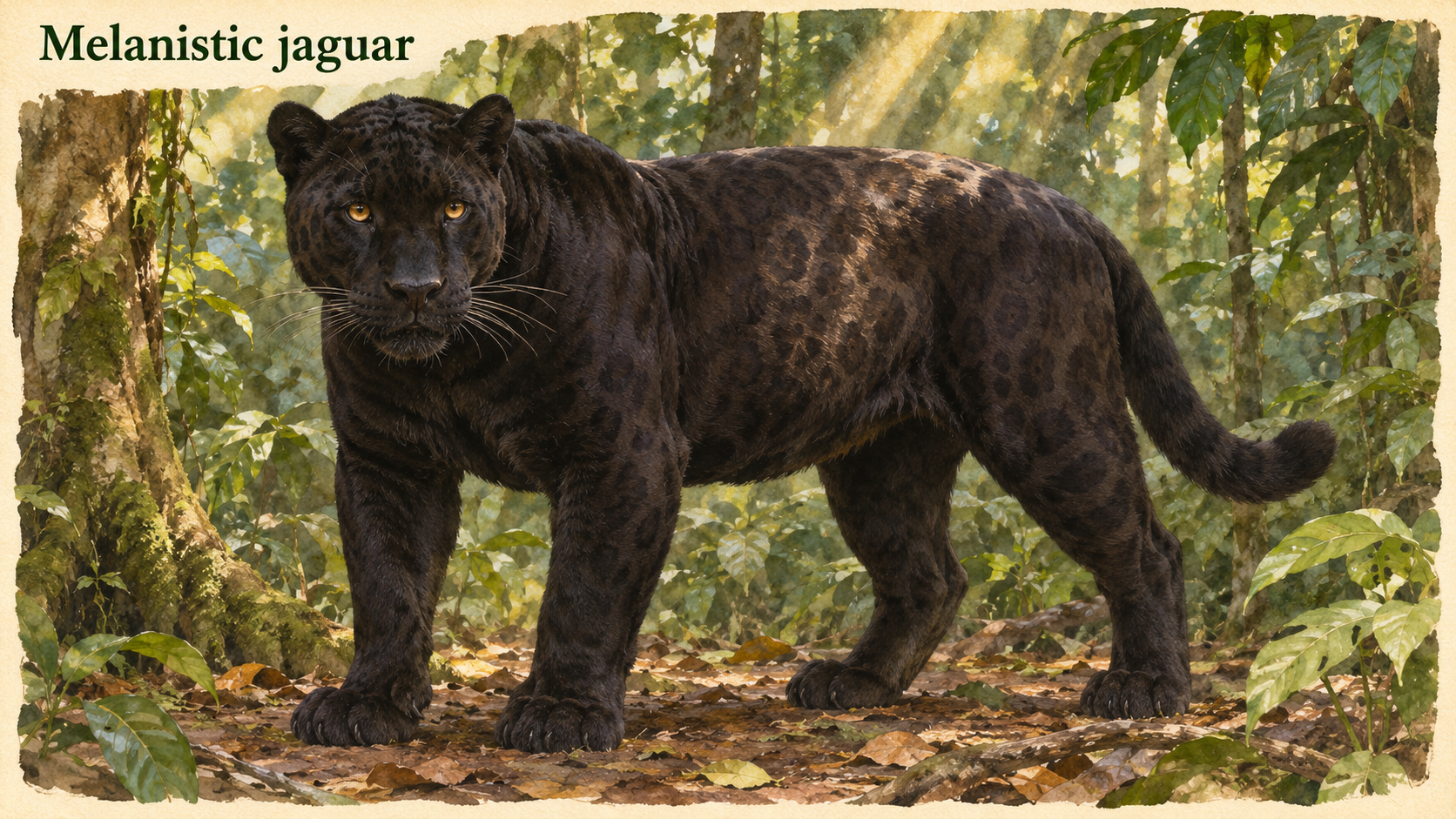
Black panther is a common description, rather than the name of a separate species. Both jaguars and leopards can have unusually dark coats, a condition called melanism. Their markings remain present and may become visible in suitable light. A black coat therefore does not resolve the jaguar-versus-leopard question.
The same clues still help: where the animal occurs naturally, how broad its head looks, the length of its tail, and any rosettes that can be seen. If the photograph lacks those details, a confident label may be impossible. Keeping the identification open is more useful than treating black panther as a third answer.
Explore more wild cat names in our guides to animals that start with J and animals that start with L.


James Miller grew up on the Oregon coast, exploring tide pools and watching seabirds. He has a particular fondness for owls and keeps a notebook of his bird sightings.
Read More »