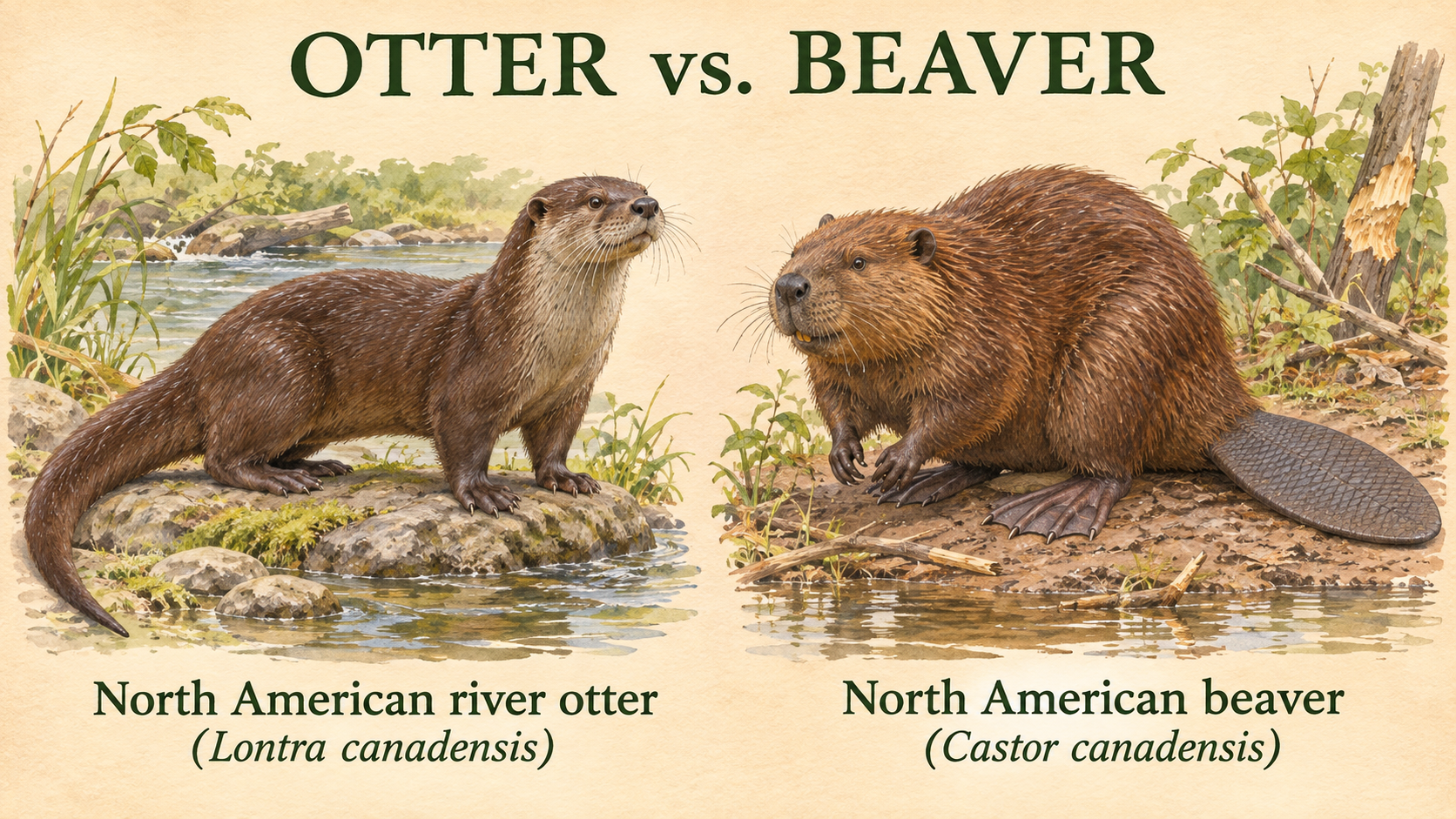
The tail is often the quickest way to tell a river otter from a beaver. A North American river otter has a long, muscular, furry tail that tapers toward the tip. A North American beaver has a broad, flat, scaly paddle. The otter is long and sleek, while the beaver has a much stockier body.
Their family relationships and daily lives differ too. The river otter, Lontra canadensis, is a mustelid, related to weasels and mink. The beaver, Castor canadensis, is a rodent. Sharing a pond or stream does not mean they are close equivalents: one hunts animal prey, while the other eats plants and can reshape the waterway.
River Otter and Beaver at a Glance
| Feature | North American river otter | North American beaver |
|---|---|---|
| Body | Long, sleek and cylindrical | Stocky and rounded |
| Tail | Long, furry and tapered | Broad, flat and scaly |
| Family relationship | Mustelid in the weasel family | Rodent |
| Feet | Webbed feet on short legs | Large webbed hind feet and smaller front paws |
| Food | Fish, crayfish and other animals | Leaves, stems, twigs, bark and other plant foods |
| Habitat use | Hunts in waterways and travels on land | Uses waterways and may create ponds by damming |
| Head clues | Small rounded ears and prominent whiskers | Broad head with large orange front incisors |
1. Start with the Tail, Then Check the Body
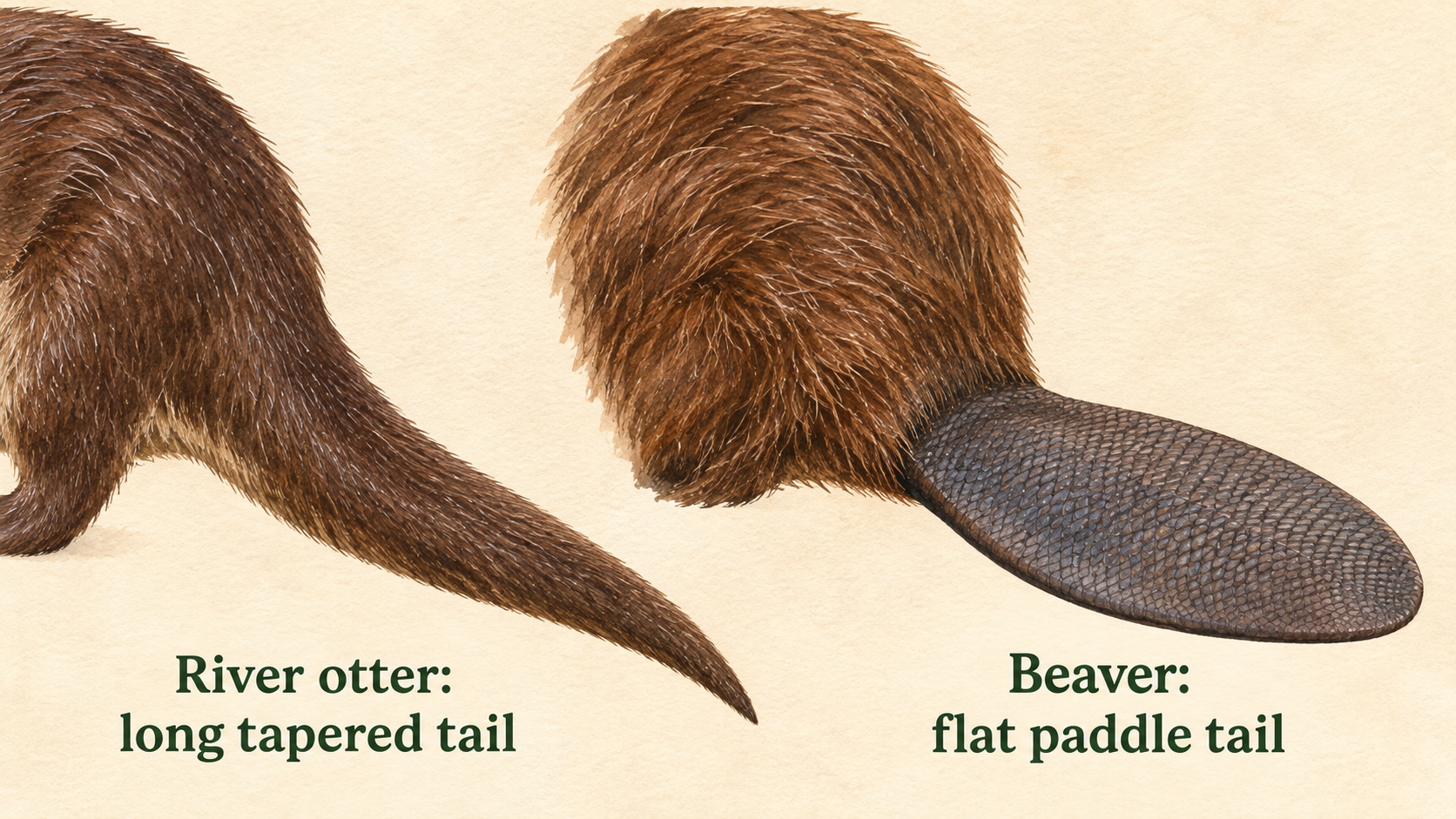
The otter’s tapered tail continues the line of its long body. Short legs and webbed feet complete a shape suited to maneuvering through water. Its dense coat is usually dark brown, with a paler throat and cheeks. The small head and prominent whiskers give another useful impression when the rest of the animal is submerged.
A beaver’s paddle looks different in both outline and texture. It is broad and flattened, with a scaly surface rather than a covering of long fur. The beaver can use it as a rudder in water and a support on land. A side-on view may make the paddle look narrow, so the viewing angle matters.
2. Both Swim Well, with Different Proportions
River otters have webbed feet and a streamlined body suited to aquatic hunting. They can also travel on land between waterways. Beavers are strong swimmers too, with large webbed hind feet and a heavy body that can appear surprisingly unobtrusive at the surface. A swimming animal may hide its most useful identification features underwater.
If only a head is visible, look for another view of the back, body length, or tail rather than judging from brown fur alone. Watching a natural change in position can reveal far more than moving closer. A distant photograph that includes the whole animal is particularly useful for comparing proportions.
3. Food Is a Major Difference
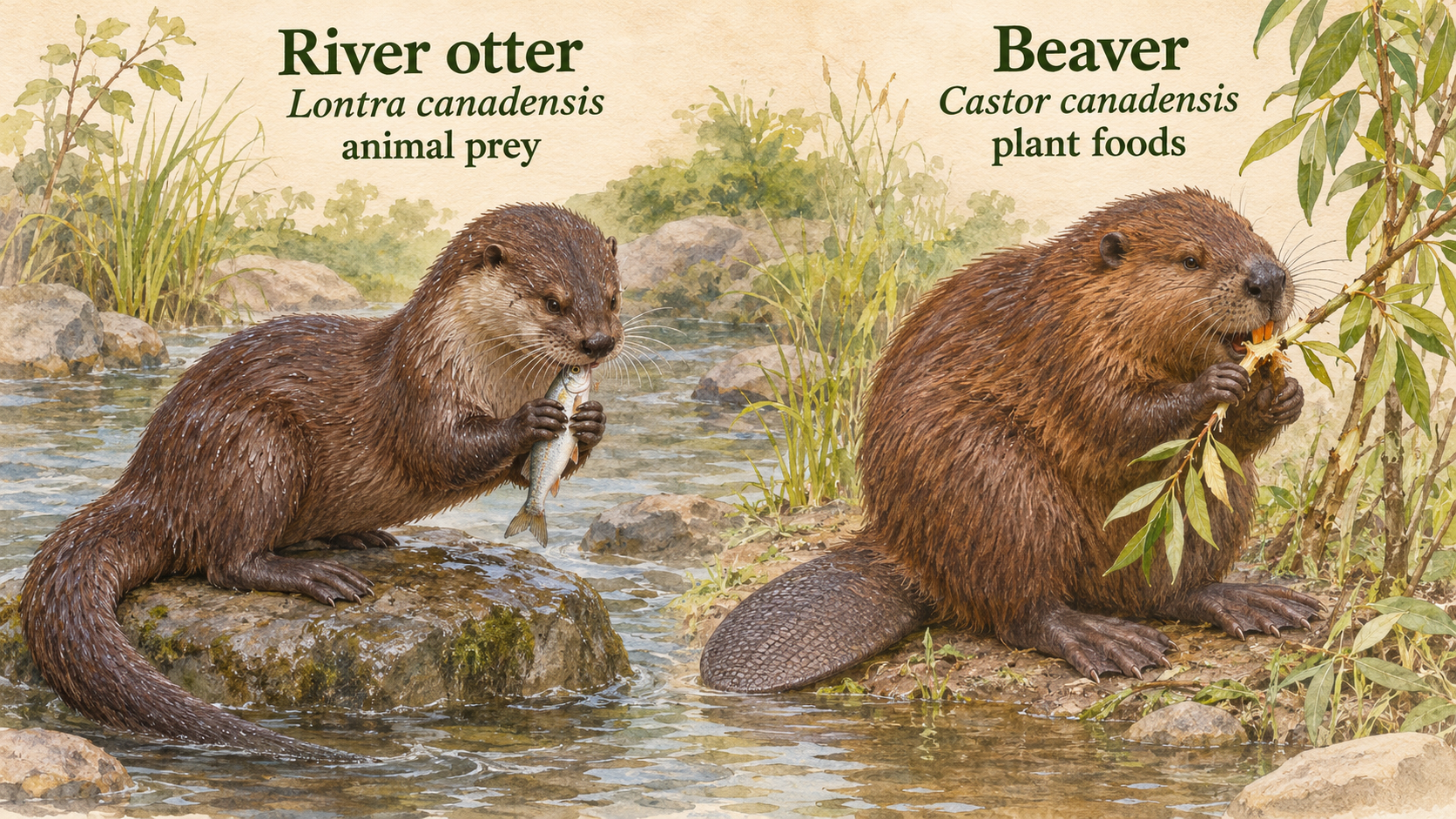
River otters are carnivores. Fish and crayfish are important foods, and their prey can also include amphibians, turtles, insects, and small mammals. Their aquatic hunting helps explain the streamlined body, mobile limbs, and sensitive-looking whiskers. The animal is searching for food in the water, rather than cutting wood to build a barrier.
Beavers eat plant material. During the growing season, their foods include leaves, buds, stems, and aquatic vegetation. Woody foods such as bark and twigs become especially useful outside that season. Their conspicuous orange incisors grow continuously and are suited to gnawing. A cut branch is connected with both feeding and the beaver’s building activities.
4. Beavers Can Change the Waterway
Beavers build dams that can create ponds and areas of slow-moving water. The resulting wet habitat can support other animals as well as the beavers themselves. This is why they are often called ecosystem engineers: their activities change the physical setting, rather than simply using the habitat that was already there.
River otters use lakes, ponds, streams, wetlands, and coastal areas as feeding and travel habitat. A beaver-shaped wetland may therefore contain several kinds of aquatic mammal. The presence of a dam is a clue about how the habitat developed, not proof that every animal swimming nearby is a beaver.
5. River Otters Are Not Restricted to Rivers
Despite their name, North American river otters can also occur along the coast. In Olympic National Park, they forage in intertidal areas and are sometimes confused with sea otters. The word river describes a familiar association, rather than an absolute limit on where the species can be found.
Sea otters are another species and deserve their own comparison. For the river otter-versus-beaver question, a full tail view, overall body shape, and feeding behavior provide the clearest foundation. Putting those clues together is more dependable than deciding from the water body’s name.
Find more mammal names in our guides to animals that start with O and animals that start with B.


James Miller grew up on the Oregon coast, exploring tide pools and watching seabirds. He has a particular fondness for owls and keeps a notebook of his bird sightings.
Read More »