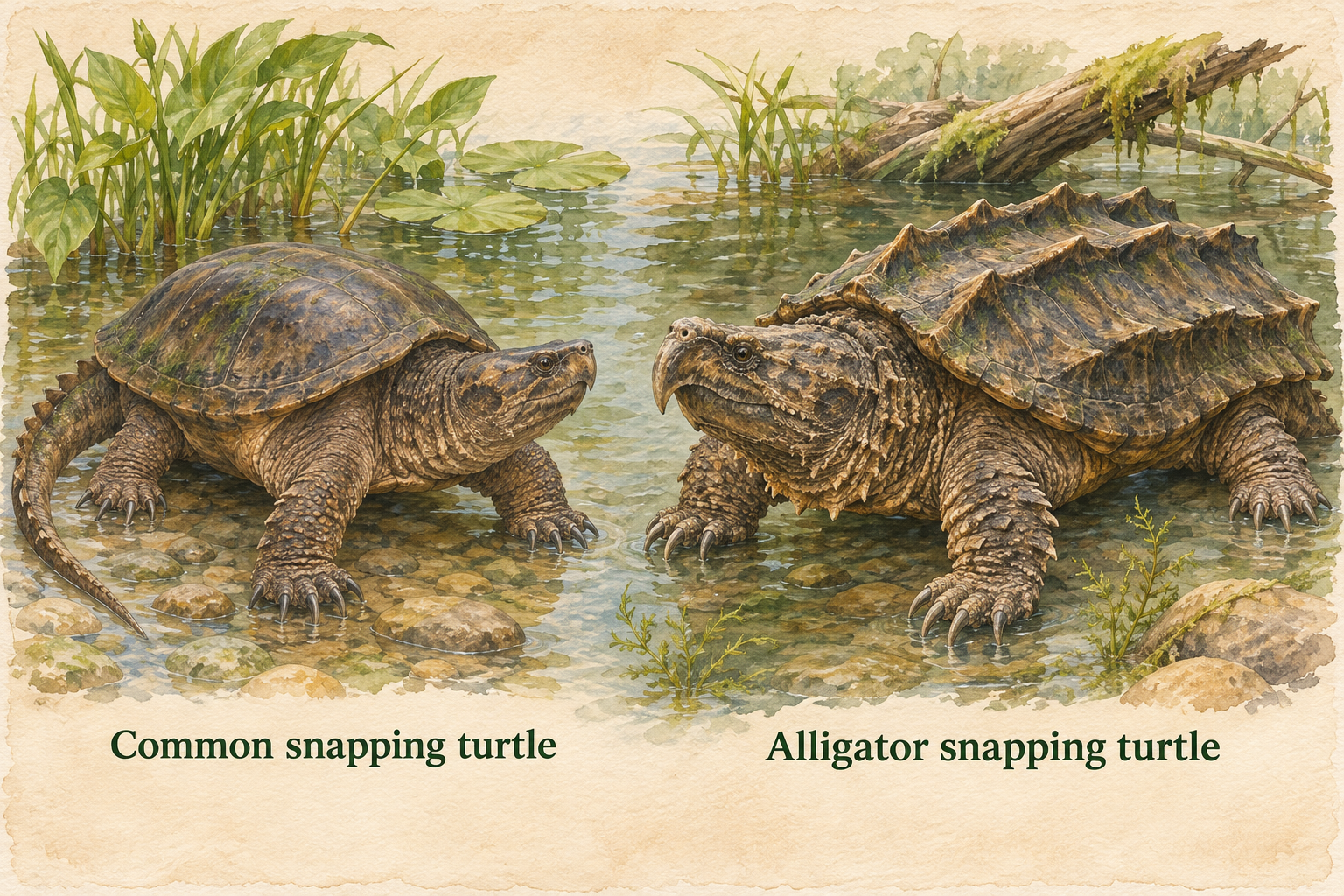
An adult alligator snapping turtle usually looks more heavily armored than a common snapping turtle. Three strong ridges run along its upper shell, and its head is broad with a pronounced hooked beak. A common snapper’s shell becomes relatively smoother with age, and its head is smaller in proportion. Both have long tails and powerful jaws.
The common snapping turtle is Chelydra serpentina. Alligator snapping turtles belong to Macrochelys; the western alligator snapping turtle, M. temminckii, is the example used here. A careful comparison uses several visible features rather than size or a dramatic-looking face alone. Young common snappers can have ridged shells too.
| Feature | Common snapping turtle | Alligator snapping turtle |
|---|---|---|
| Adult upper shell | Relatively smooth, with low ridges | Three prominent rows of raised keels |
| Head | Large, but smaller in proportion | Very broad, massive head |
| Beak | Hooked cutting edge | Especially prominent hooked beak |
| Eye view from above | Eyes can be visible | Eyes set more toward the sides |
| Tail detail | Saw-toothed crest is conspicuous | Long muscular tail with rounded bumps |
| Feeding clue | Varied omnivore | Wormlike mouth lure used in ambush |
The Adult Shell Is a Strong Clue
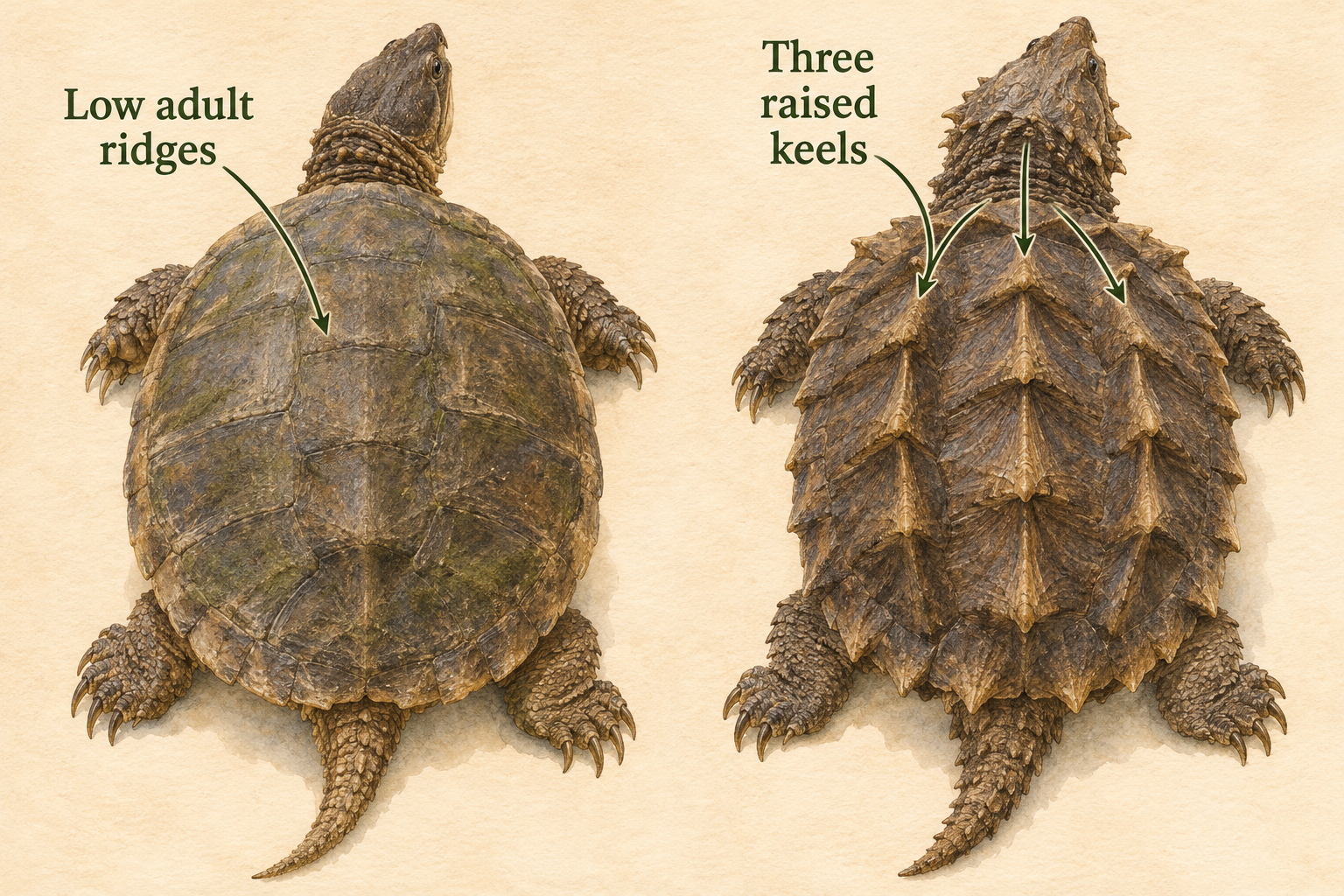
The alligator snapper’s three keels form distinct lengthwise rows: one along the center and one on either side. Raised scutes give the shell a rugged profile. Common snapping turtles have lower ridges that often wear down as the animal grows. A young common snapper may therefore look rougher than the smoother adult silhouette people expect.
Mud, algae, and the viewing angle can conceal shell details. If the top is partly submerged, one ridge may be visible while the others disappear. A side photograph that shows only the rear edge also loses much of the comparison. Look at the whole carapace, or upper shell, before assigning much weight to one apparently spiky patch.
Compare the Head, Eyes, and Tail Together
An alligator snapping turtle has a particularly large triangular head and strongly hooked beak. Its eyes are placed toward the sides, so they are less evident from directly above. A common snapper’s eyes can be seen from that angle. These are supporting clues that work best when the turtle is naturally visible rather than partly buried.
Both turtles have long tails, so a tail alone does not distinguish them. The common snapper’s saw-toothed top edge is a characteristic feature. Alligator snappers have rounded tail bumps and numerous fleshy projections on the head and limbs. Neither turtle needs to be turned over or encouraged to open its mouth for an identification.
The Alligator Snapper Has a Built-In Lure
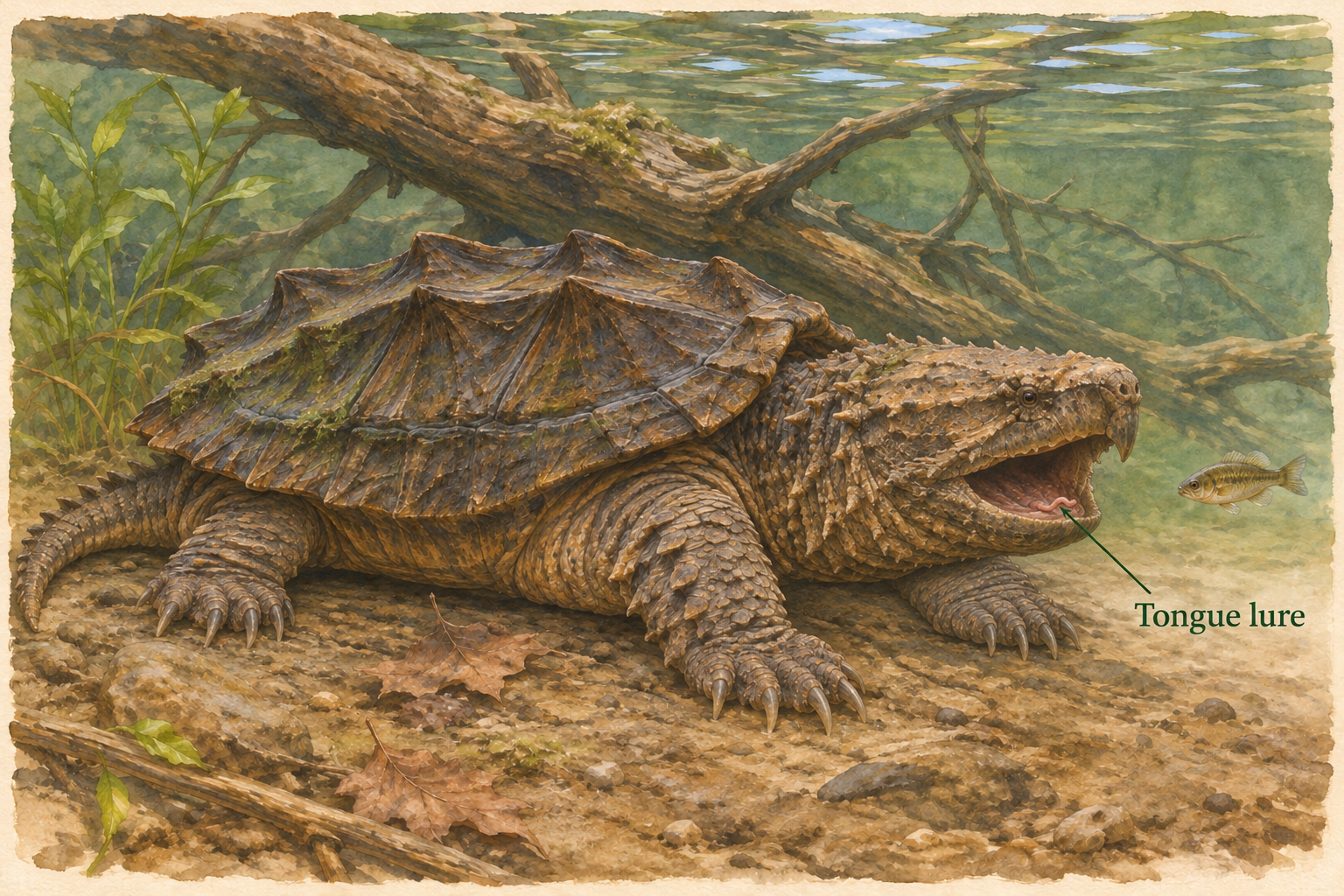
An alligator snapping turtle can wait with its mouth open and wriggle a small wormlike appendage on its tongue. A fish approaching the apparent food comes within reach of the jaws. This is an ambush technique, not the animal waving a separate worm around. The lure is part of the turtle’s own mouth anatomy.
The lure does not mean that alligator snappers eat only fish. Their foods include other aquatic animals, carrion, and some plant material. Common snappers also eat a wide mixture, including vegetation, invertebrates, and vertebrate prey. They can wait concealed and lunge forward, so the presence of ambush feeding alone is not exclusive to alligator snappers.
Habitat Helps, but Anatomy Decides
Common snapping turtles occupy varied ponds, wetlands, streams, and other waters over a broad North American range. Alligator snappers are associated with southern and southeastern freshwater systems, often deeper rivers and places with submerged wood or root masses. Location helps narrow an identification, but a pond-like background in a photograph cannot establish the species on its own.
A turtle on land may be traveling between waters or seeking a nesting site, rather than showing its usual daily habitat. Observe the shell and head from a distance and leave the animal undisturbed. For other reptiles and freshwater animals, explore our guide to animals that start with T.


James Miller grew up on the Oregon coast, exploring tide pools and watching seabirds. He has a particular fondness for owls and keeps a notebook of his bird sightings.
Read More »