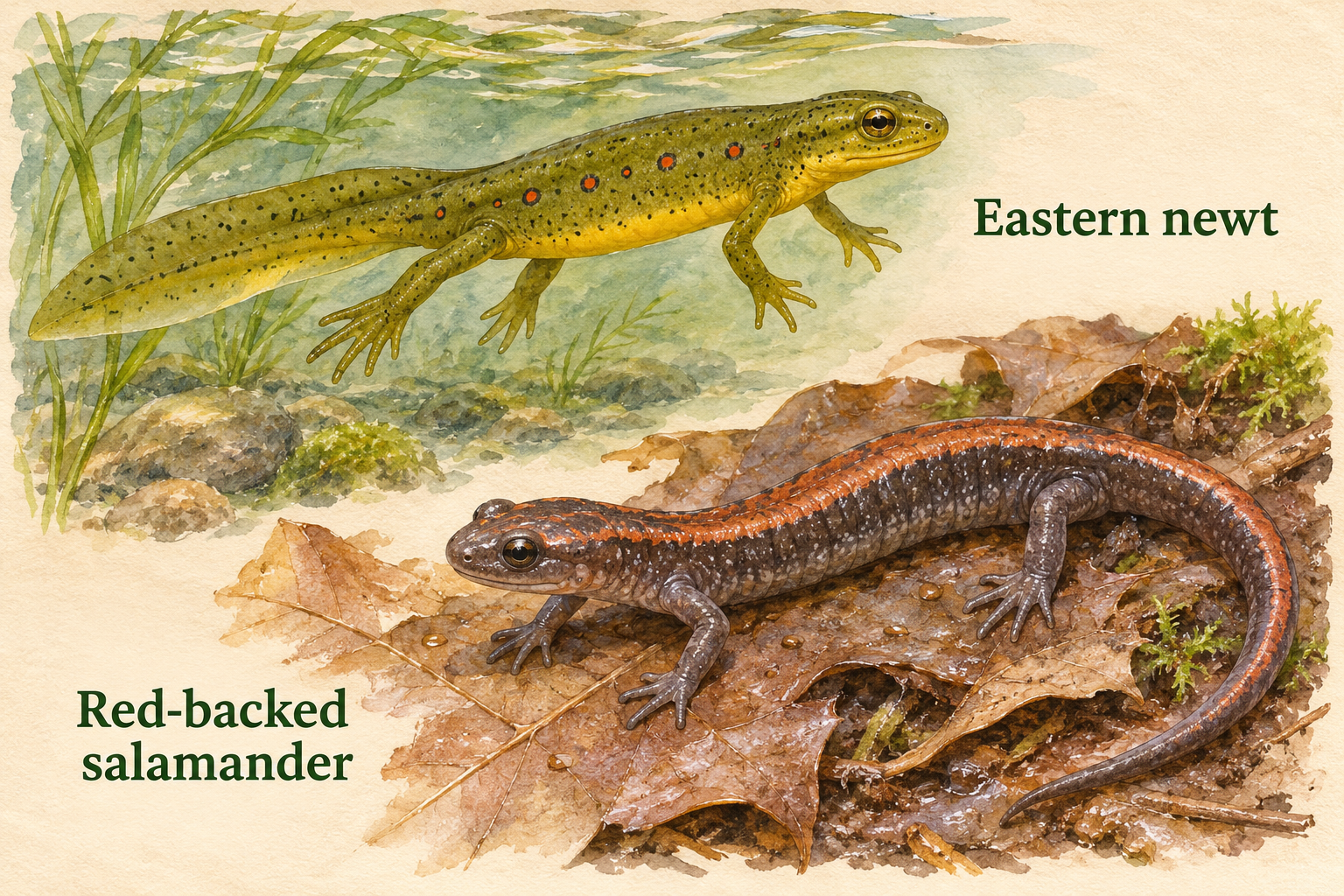
All newts are salamanders, but many salamanders are not newts. The names describe a group within a larger group, rather than two completely separate kinds of animal. Newts are members of the salamander family Salamandridae. Salamanders as a whole include several other families, with very different bodies and life cycles.
A rough skin texture or a flattened swimming tail can suggest a newt, but neither feature should replace a species identification. Newts change as they grow and move between habitats. The familiar bright orange eastern newt on a woodland trail can look very different from the olive animal swimming in a nearby pond.
| Question | Useful answer |
|---|---|
| Is a newt a salamander? | Yes; newt is a more specific common name. |
| Are all salamanders newts? | No; the wider group includes many other families. |
| Does a newt always live in water? | No; terrestrial stages or seasons occur in many species. |
| Does rough skin prove it is a newt? | No; skin changes with species, stage, and season. |
| What is a red eft? | A terrestrial stage in the eastern newt’s life cycle. |
| What else helps identification? | Local range, markings, tail, and life stage. |
A Family Name Is Not the Whole Salamander Group
Salamandridae includes newts and animals commonly called true salamanders. Other salamanders belong elsewhere: eastern red-backed salamanders, for example, are in Plethodontidae, the lungless salamander family. A broad name can remain useful even when it covers several distinct branches. Calling a newt a salamander is correct; calling every salamander a newt is not.
Scientific names help when common names vary. The eastern newt is Notophthalmus viridescens; the rough-skinned newt is Taricha granulosa. Both are salamandrids, even though their colors and habits are not identical. A field guide organized by local species can resolve these relationships more clearly than a simple list of smooth versus rough animals.
The Red Eft Is a Life Stage
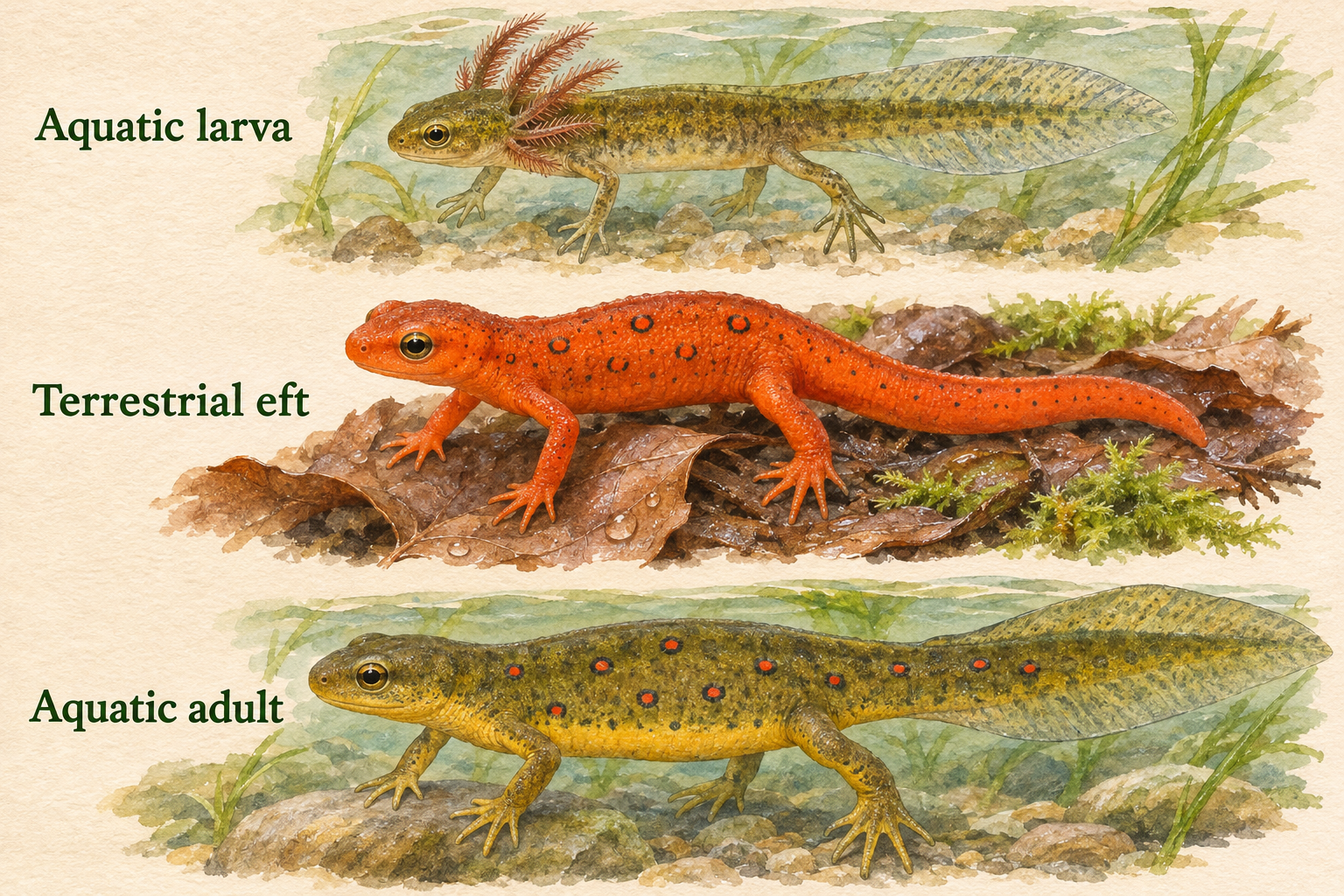
The eastern newt often begins as an aquatic larva with external gills. It then develops into an orange-red terrestrial stage called an eft. Efts move through damp woodland and leaf litter. Later, many return to water as olive or greenish-brown adults with yellow undersides and black-bordered red spots. These appearances belong to one species.
The pattern is not a rigid timetable for every individual. Some populations follow alternative routes, including animals that mature while retaining aquatic features or adults that spend time on land. A red eft is therefore useful evidence about a familiar stage, but eft is not a synonym for every salamander larva.
Skin and Tail Change with the Setting
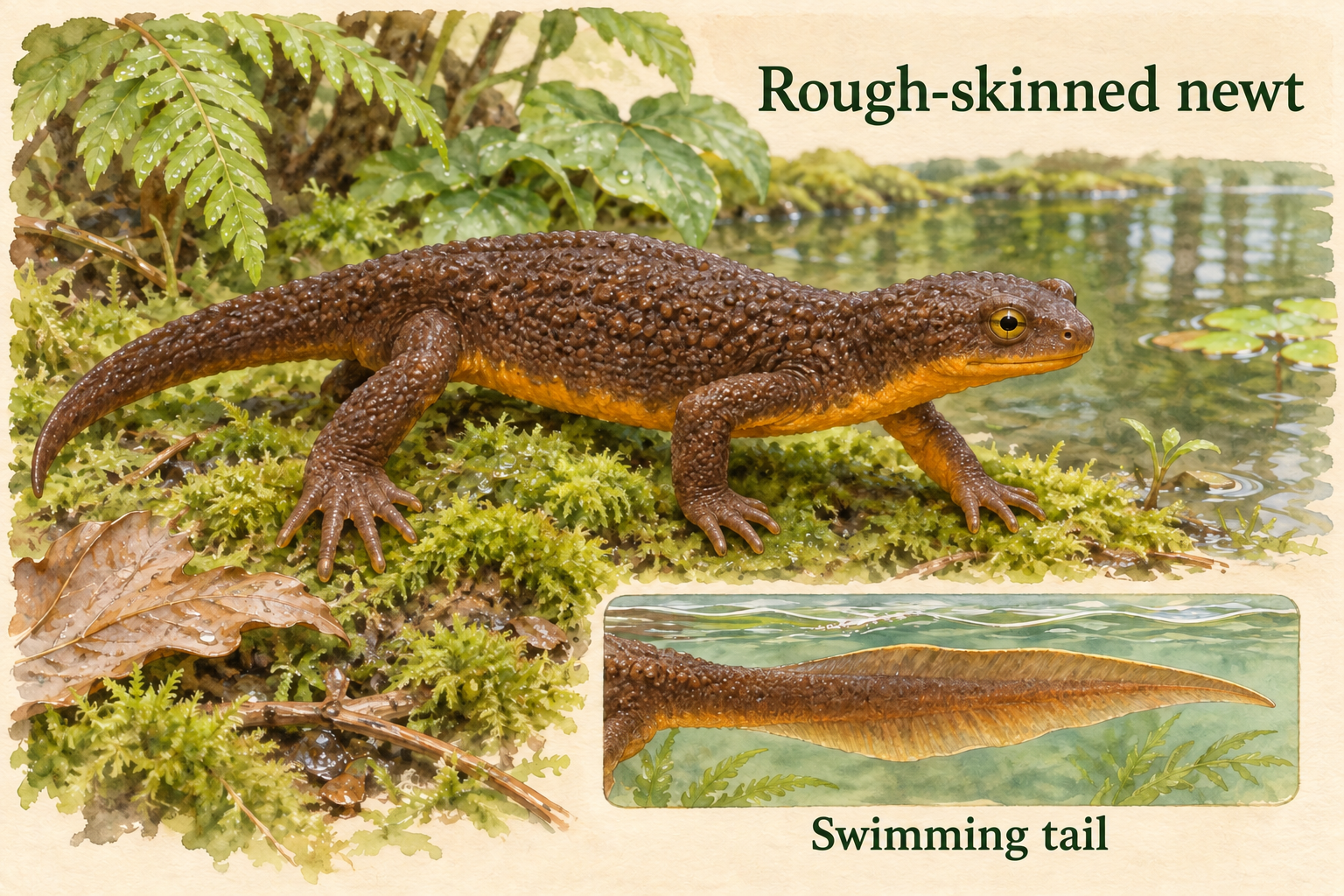
The rough-skinned newt has granular brown skin above and a bright orange to yellow-orange underside. It can use both woodland and freshwater habitats. During aquatic breeding periods, males become smoother-skinned and develop a more conspicuous tail crest. A rough-looking land animal and a smoother aquatic one may therefore be the same species in different conditions.
A laterally flattened tail moves through water like a paddle. It is a useful observation when comparing an aquatic adult newt with a small terrestrial salamander that has a more rounded tail. It is not a universal family boundary, however: the wider salamander group also includes animals adapted to an entirely aquatic life.
Other Salamanders Follow Other Paths
Eastern red-backed salamanders lay eggs in damp terrestrial places, and their young hatch without a free-swimming aquatic larval stage. Adults have no lungs, exchanging gases through moist skin and mouth tissues. That life is very different from the familiar pond-and-eft newt story, even though both animals are salamanders.
Some salamanders stay aquatic and retain gills; others use lungs or depend heavily on skin breathing. The name alone cannot supply a complete life history. For identification, record markings, tail form, habitat, and the local species possibilities together. Explore more amphibians in our guides to animals that start with N and animals that start with S.


James Miller grew up on the Oregon coast, exploring tide pools and watching seabirds. He has a particular fondness for owls and keeps a notebook of his bird sightings.
Read More »