A puffin can fly; a penguin cannot. Both are seabirds that use their wings to move underwater, and both can have striking black-and-white plumage. Their resemblance reflects the demands of a marine life, but they belong to different bird families and have followed different evolutionary paths.
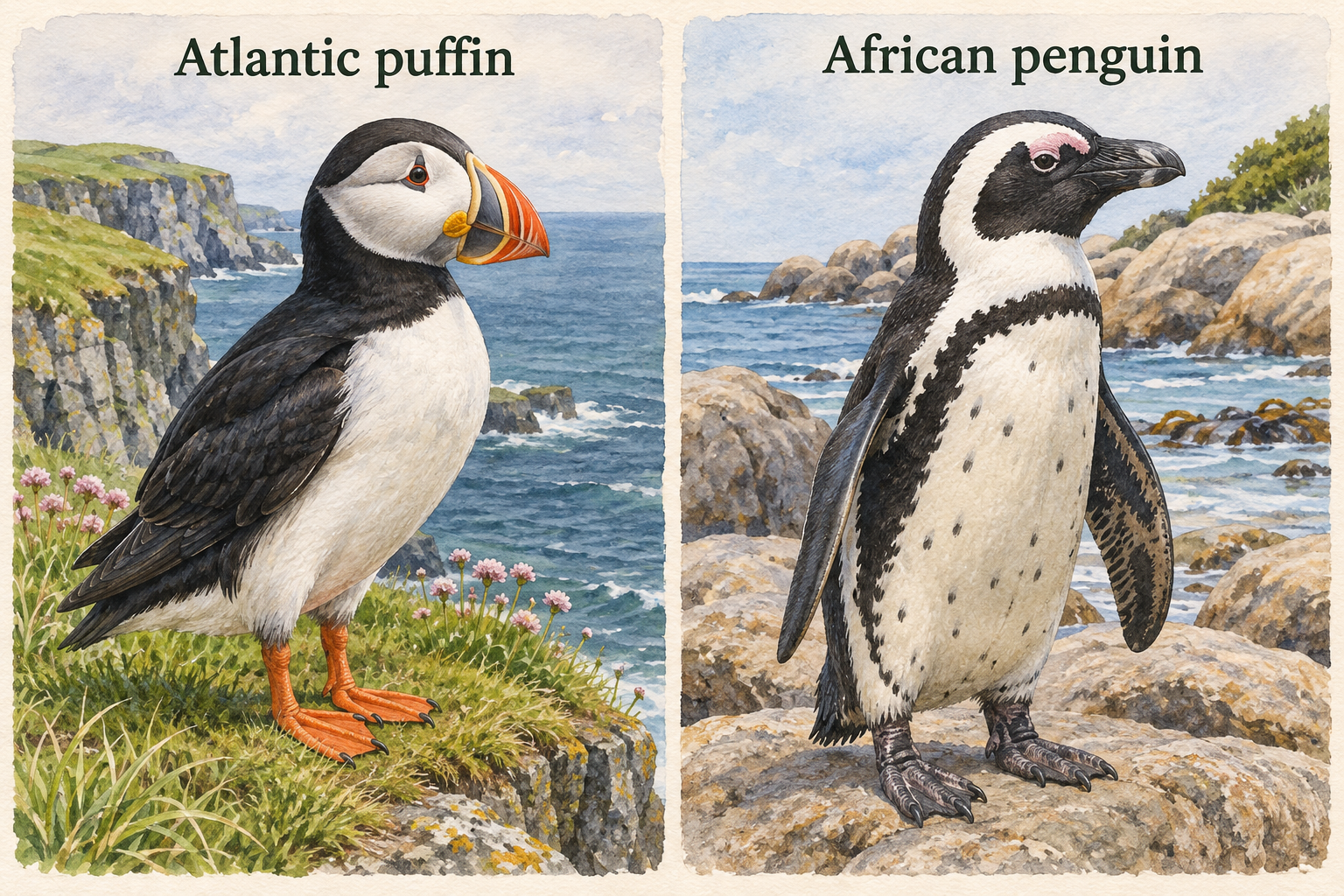
Puffins belong to Alcidae, the auk family. Penguins belong to Spheniscidae. The Atlantic puffin and African penguin make useful examples here, although neither represents every color, size, or nesting habit within its group. A penguin is not simply a southern puffin, and a puffin is not a small flying penguin.
| Feature | Puffins | Penguins |
|---|---|---|
| Family | Alcidae, with other auks | Spheniscidae |
| Flight in air | Able to fly | Flightless |
| Underwater movement | Wing-propelled diving | Stiff flippers propel swimming |
| Wild range | Northern Atlantic and Pacific waters | Mainly Southern Hemisphere, reaching the equator |
| Useful example | Atlantic puffin has a large triangular seasonal bill | African penguin has a pointed bill and chest band |
| Nest variation | Burrows or rock crevices, depending on species | Burrows, ground nests, and other sites, depending on species |
Wings Have Different Jobs Above the Surface
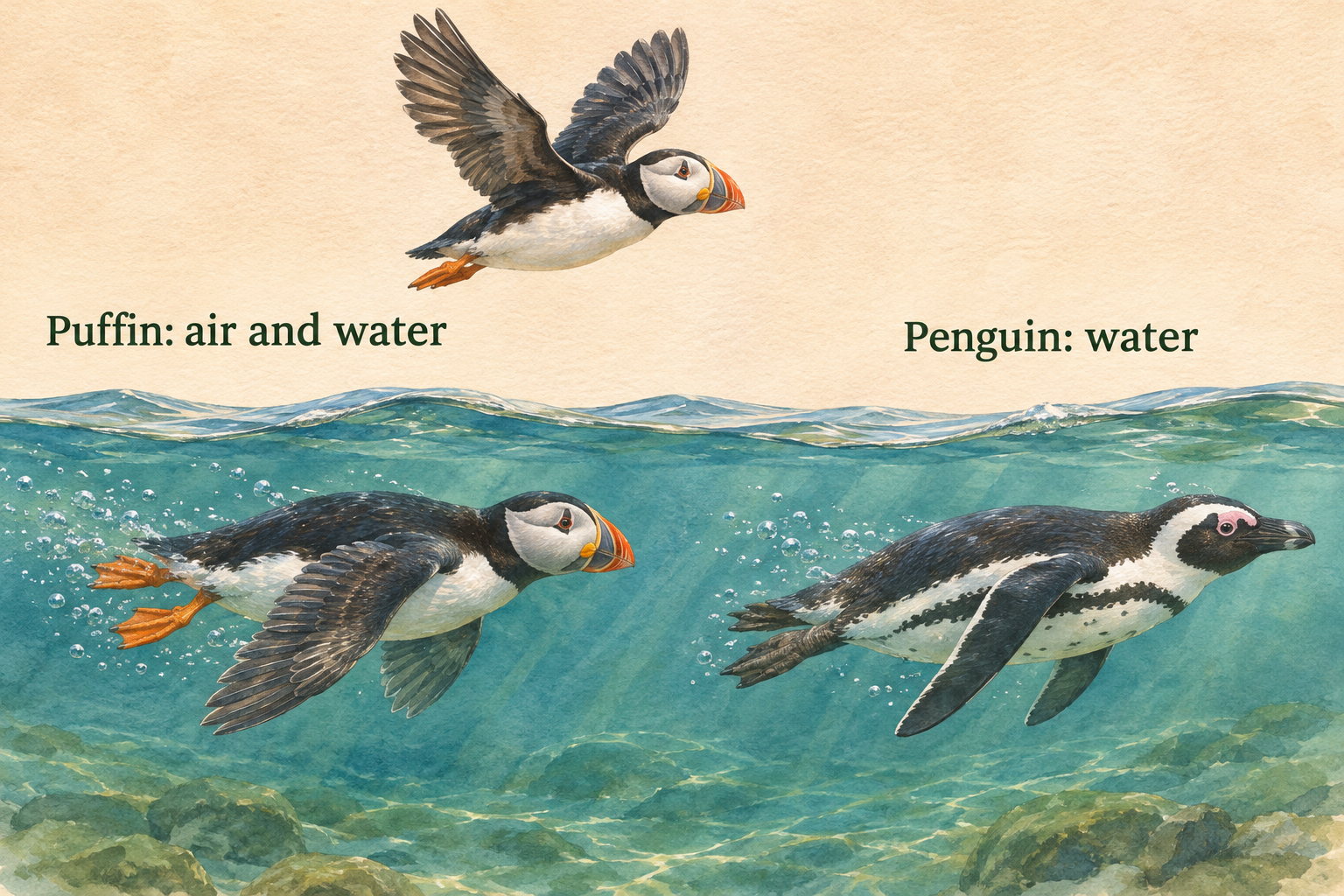
An Atlantic puffin flies with rapid beats of its short wings. Below the surface, the same wings propel it after prey. That dual role constrains the bird’s design: a wing has to work in both air and much denser water. The seemingly frantic flight and purposeful diving belong to the same animal.
Penguin wings are stiff, flattened flippers. Their bones and muscles form a powerful swimming system, and the body is streamlined for traveling beneath the waves. Feet help with steering. On land, the rearward position of the legs contributes to an upright walk, but underwater the body becomes much more obviously suited to its surroundings.
North and South, with an Equatorial Exception
Atlantic puffins breed around the North Atlantic. Horned and tufted puffins are Pacific birds; Alaska offers places where both occur. The tufted puffin has conspicuous pale head plumes in breeding season, while a horned puffin has a small fleshy projection above the eye. Not every puffin has the classic Atlantic puffin face.
Penguins occur mainly in the Southern Hemisphere, from Antarctic settings to temperate coasts and islands. Galápagos penguins live around the equator. African penguins occupy southwestern African shores and swim in cool coastal waters. Snow and ice are therefore poor requirements for identifying a penguin; several species breed in landscapes with sand, rocks, and shrubs.
A Bright Puffin Bill Is Seasonal
A breeding Atlantic puffin has a broad triangular bill with bright orange, yellow, and gray areas. Outside breeding season, the face is grayer and the bill loses some of its colorful outer features. Young birds have smaller, darker bills. A duller bird at sea can still be an Atlantic puffin.
African penguins have a sharply pointed bill, a black band across the chest, and small dark spots on the pale underside. Bare skin above the eyes helps them release heat. Other penguins have other markings, including head crests or colored neck patches. Look for a species pattern, rather than treating black-and-white plumage as a complete identification.
Nesting Habits Vary Within Both Groups
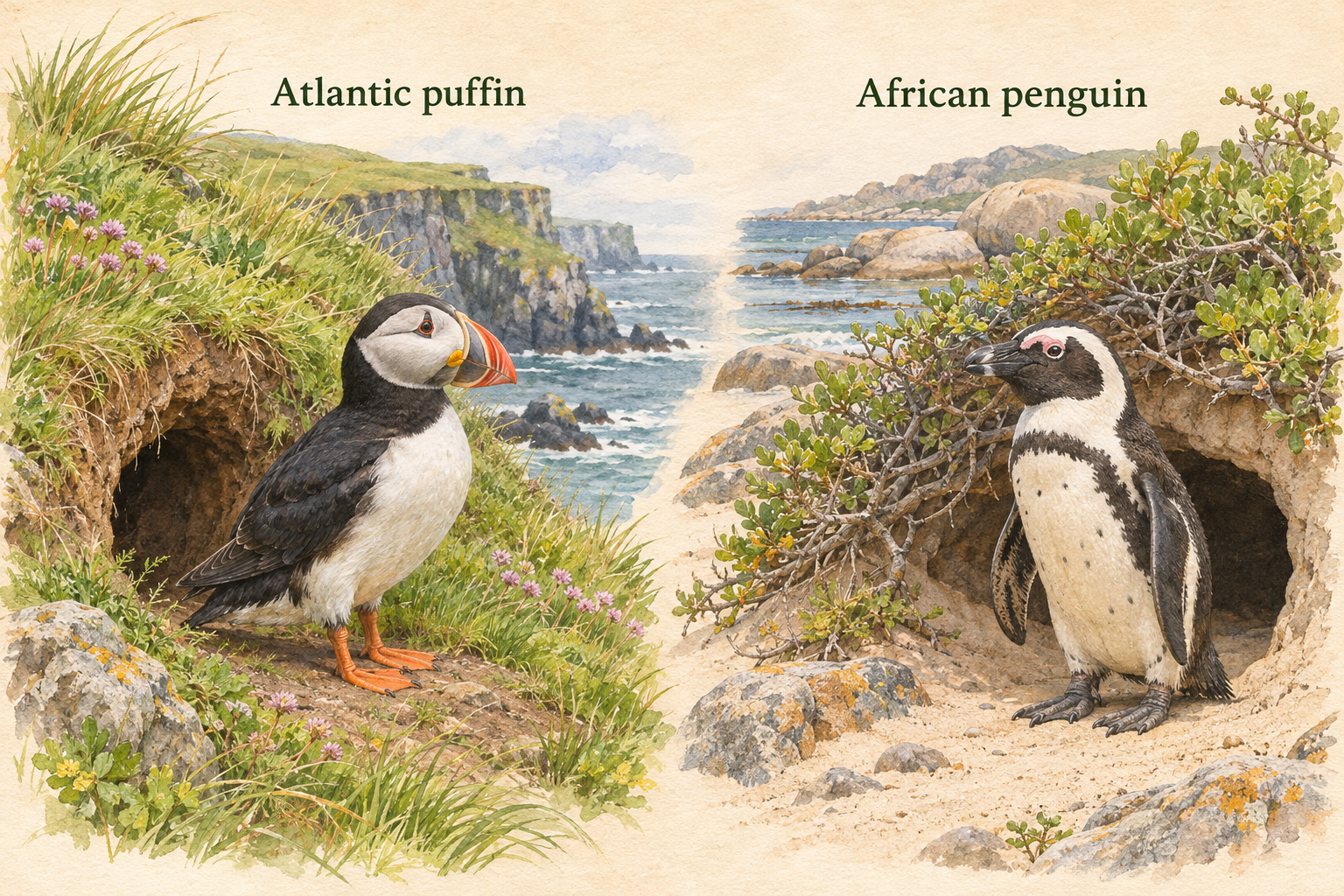
Atlantic puffins commonly nest in burrows on islands and return to sea outside the breeding season. Tufted puffins also dig burrows, while horned puffins often use rock crevices. Adults can carry small fish crosswise in their bills to their chicks. A puffin holding several fish is often on a provisioning trip to a nest.
African penguins use sheltered nest sites such as burrows, spaces beneath rocks, and cover under bushes. Other penguins may build exposed ground nests or follow very different breeding routines. The flight distinction remains the quickest comparison, while bill, range, and species-specific markings provide the detail. Explore more seabirds in our guide to animals that start with P.


James Miller grew up on the Oregon coast, exploring tide pools and watching seabirds. He has a particular fondness for owls and keeps a notebook of his bird sightings.
Read More »